

- Words
- Harriet Richardson
- Illustrations
- Tara Booth
- —
- Date
- 19 August 2026
- Tags
I bumped into my ex (boss): Harriet Richardson on life after design
A chance encounter causes the graphic designer turned performance artist to look back on her design career and consider the creative skills that she took with her into the next (professional) life.
Share
Share
“Oh my god – John!?”
As a devout fantasist, I often imagine bumping into people I know in the street. An ex-boyfriend as I bounce down Broadway Market on day two of a fresh trim. Delicious. Or an ex-boyfriend, as I step out of a black cab outside some restaurant I can’t afford. Perfection. Or even an ex-boyfriend, as I laugh at something charming and unknowable behind the glass of an independently owned coffee shop, bob dancing in the air-conditioning.
Okay, they’re mainly ex-boyfriends on good hair days.
But this day’s collision was even better.
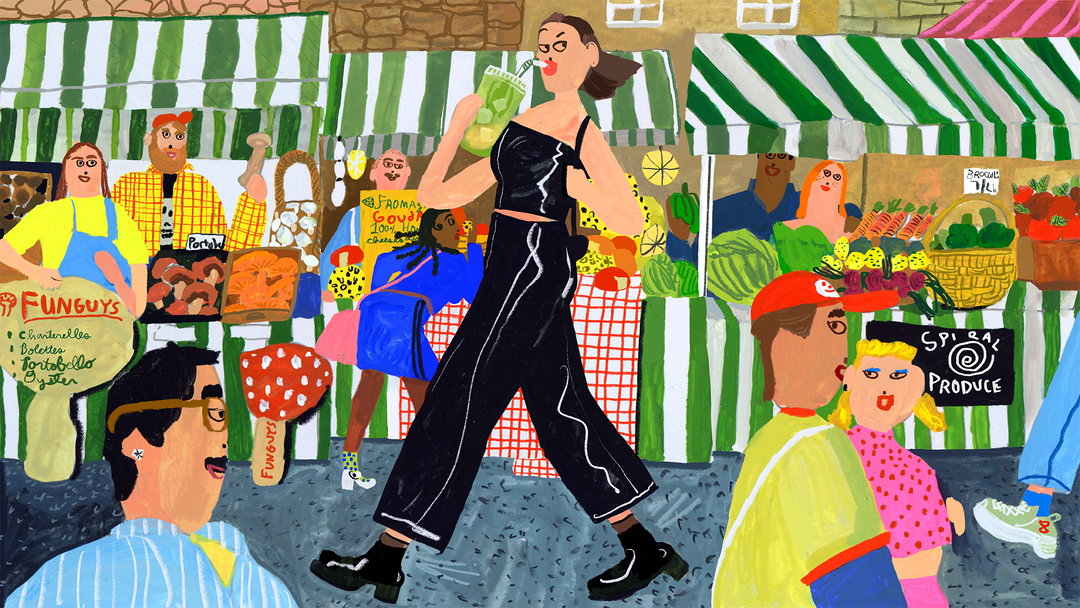
I hadn’t thought of this one before. Because there, completely out of context, on a random London pavement, was my ex-boss of five years. And I, on my way to perform a sold-out work-in-progress of my upcoming Edinburgh Fringe debut hour – freshly straightened do, dressed in all-black pleather, clutching a Blank Street Oat Milk Banana Split Iced Matcha Latte to go.
Dreams do come true, you just don’t realise they’re dreams sometimes.
“Harriet!” exclaims John. It took him a few moments to place me, which I put down to my otherworldly shiny bob, and not the fact that when we last saw each other regularly, I was 25, exhausted and trying to make a living through the soul-bending act of moving text boxes around.
John looks good. I’m not just saying that because he employed me for five years and didn’t once threaten to return me to the North, but because John always looked good. He has the immaculate, expensive ease of a man who has spent decades in rooms with luxury brands, beautiful objects, and people who own Eames chairs but don’t tell people they own Eames chairs.
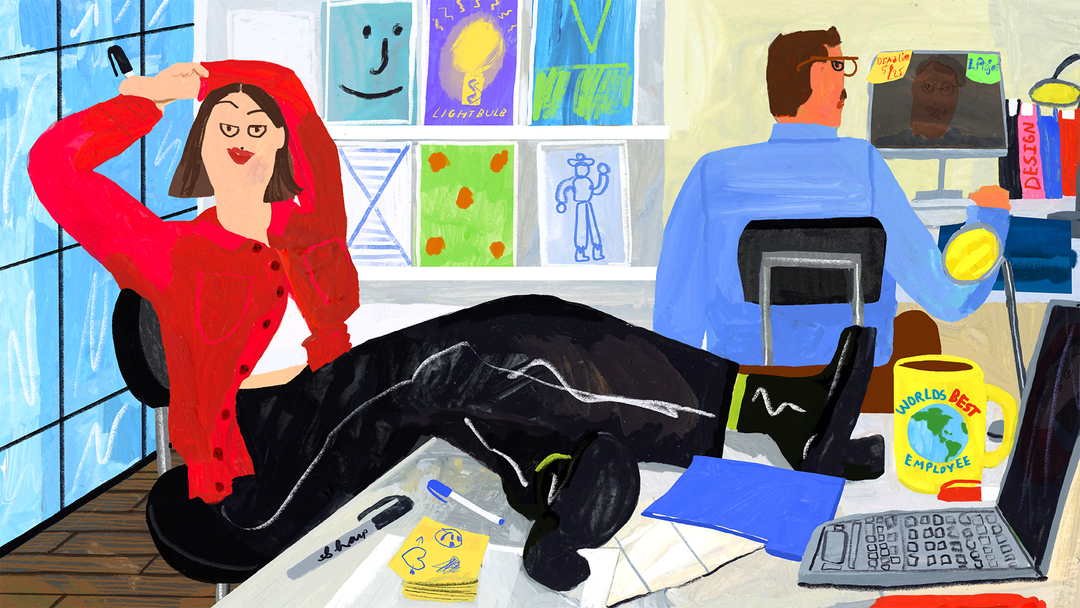
For five years, I worked on his team as a graphic designer at Pentagram, which is the sort of sentence I used to say before tucking my aforementioned otherworldly bob behind my ear so I could fully absorb the echoing gasps of recognition. Pentagram is one of the most famous design studios in the world. When I first got the job, I felt like I’d been handed a golden ticket, and that my life as a famous Graphic Designer was about to begin.
And John, to me, embodied the whole thing: taste, restraint, references I pretended to understand. He could talk about a line weight or a shade of grey with the seriousness of a surgeon discussing an artery, all whilst working with clients whose customers would think a Dairylea Dunker was a collaboration between two Danish architects.
His inability to open a PDF was dwarfed by his almost supernatural design instinct. You could spend hours poring over a logo, nudging it fractions of a millimetre in every direction, and John would lean over your shoulder and say, “Make it green and move it left.” Sorted.
“The problem with dreams is they become your commute. The gold rubs off (and not just because I’d print-specced the wrong Foilco again, sorry John).”
Harriet Richardson
In my first couple of years at the company, working there felt like proof. Proof I was good. Proof I had made it. Proof that a working-class woman from the North could be on the inside.
But the problem with dreams, once you start living inside them, is that they become your commute. The gold rubs off (and not just because I’d print-specced the wrong Foilco again, sorry John). The glamour of having “made it” fades. And suddenly you’re 26, staring down another 30 years of a decision you made at 19 because graphic design was the only acceptable art form in a working-class town.
“Where are you off to?!” he asks.
Oh my god, it’s my f*cking moment. It’s my time to shine.
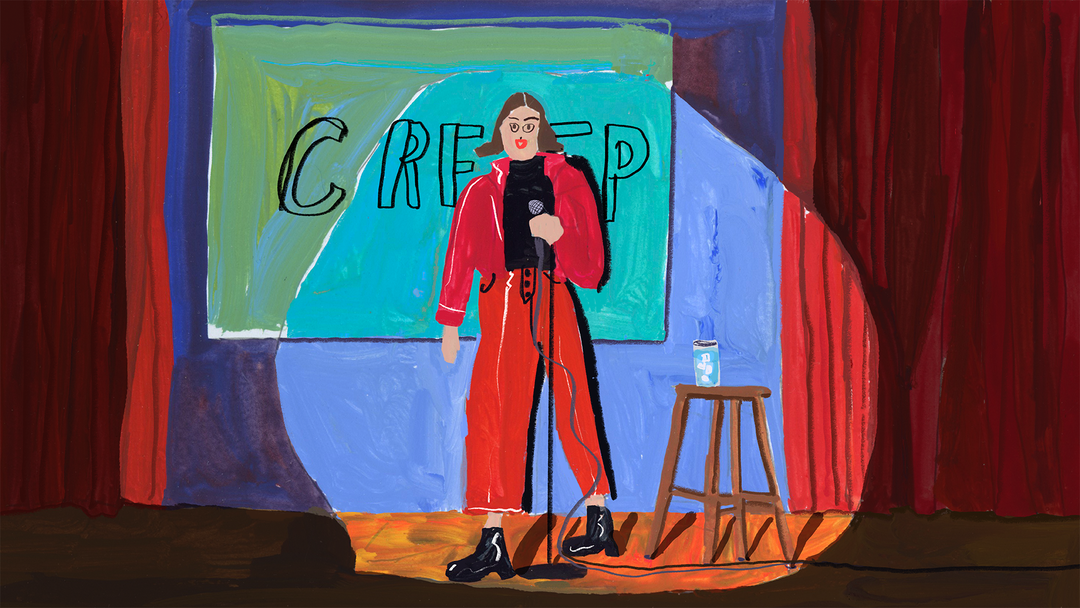
“To a comedy gig, I’m a… performance artist now.”
Yes. Yes, you are, Harriet, my subconscious squeals.
“Well…” he pauses and we both know it’s coming “you always were a bit of a comedian”.
And there it is. My old life acknowledging that my new one was the right decision. That it was there, for the taking, all along.
There were multiple reasons why I left design: exhaustion, disillusionment, the slow horror of realising I did not want my boss’ life, as wonderful as it all looked – Aesop hand soap and all. Even a creepy partner at the firm ended up being a contributing factor. But they all paled in comparison to my core reason: I knew I wasn’t in the right place, I just didn’t know where the right place was.
Designer and artist, Anthony Burrill remembers arriving at a similar point while directing a television commercial for a children’s breakfast yoghurt. “I thought to myself, ‘I went to art school for this.’ This is not what I had planned!” he tells me.
He had found himself somewhere that was no longer creatively satisfying, with nothing ahead of him but more of the same. So, in what he describes as a “bold and maybe foolhardy move”, he left his agents and production company without knowing exactly what would replace them. “It was like jumping from one moving ice flow to another,” he describes. “What was next? I didn’t know.”
In Anthony’s case, an emerging market for affordable graphic art offered somewhere to land. By making and selling his own work, he could step away from commercial commissions and towards the title he had imagined when he first went to art school: artist.
“I had mistaken the nearest door for the only door.”
Harriet Richardson
I grew up in a working-class town where creativity was encouraged, so long as it came with a payslip. There were acceptable ways to be artistic: hairdressing, decorating, nail art, graphic design. You could be creative, absolutely, but the creativity had to be useful. It had to make sense as a prospect. It had to pay rent.
Fine art, performance, writing – those things felt different. Those things were for people with holiday homes or a fireplace where a TV should be. Graphic design, on the other hand, was creative but sensible. It allowed me to make things without seeming like I had ideas above my station.
So, for a while, I resented it. Not design itself, exactly, but what it represented: the narrowness of what I had believed was possible. I had mistaken the nearest door for the only door.
And yet, annoyingly, design was brilliant for me.
Design taught me how to think. How to edit. How to make an idea legible. How to kill the bit I loved because it wasn’t serving the work. How to care about rhythm, hierarchy, tension, and restraint. How to understand that nothing is neutral: not a typeface, not an image, not a margin, not the way a thing is framed. Absolutely everything is a decision – even indecision. And there it is, in black and white (or CMYK if you’re into that sort of thing): staying somewhere you’re not meant to be, for the sake of staying, is a massive f*cking decision.
I thought leaving design meant leaving all of that behind. Instead, I took it with me.
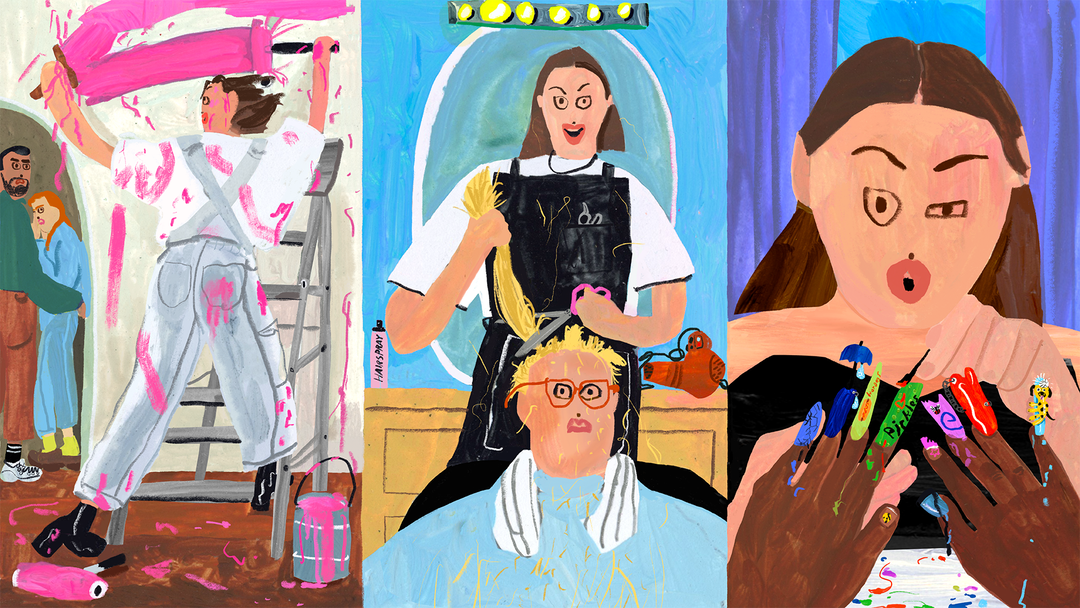
My dad, Peter Richardson, spent his own career in design. From an early age, he wanted to draw and make things, an impulse that eventually developed into a lifelong profession. But even since leaving commercial practice, at the grand old age of 60, he has found that the habits design gave him – creativity, problem-solving, invention and storytelling – still apply to everyday life. “You might leave the design industry,” he says, “but it never leaves you.”
This is perhaps the part I misunderstood when I was desperate to escape it. I thought a new life required a clean break. I wanted to become a performance artist so completely that nobody could see the designer underneath. But she is responsible for almost everything that works.
I design the posters, build the slides, structure the reveals and think about how an audience encounters an idea. I edit a comedy routine much as I would once have edited a page (but with far more enjoyment). My performances might involve dates, tattoos, obsession, shame and men from the television, but the instinct beneath them is often still a designer’s instinct.
The contemporary creative life rarely fits neatly inside a single job title anyway. Even when I called myself a graphic designer, I was never only designing. I was presenting, writing, researching, persuading, problem-solving, producing and occasionally attempting to make a client feel that their own idea had been mine. Creative work teaches adaptability because it has to. Industries shrink, technologies change, budgets disappear, tastes move on and job titles mutate faster than anyone can print them on a business card. The skills survive even when the form containing them does not.
“My performances might involve dates, tattoos, obsession, shame and men from the television, but the instinct beneath them is often still a designer’s instinct.”
Harriet Richardson
For illustrator-turned-artist Mr Bingo, leaving commercial work meant removing almost every layer that had previously existed between him and the thing he wanted to make.
“There are no clients, meetings, deadlines and no compromise,” he says.
During his 13-year commercial illustration career, he rarely felt that the final artwork was entirely his. Client work was always a combination of what he wanted to make and what the brief required. Now, everything he produces feels fully his own.
Working independently has also allowed him to create a smaller, kinder working world around himself. He sells directly to his audience, gets paid faster and pays everyone who works for him within 24 hours. “You can create a mini version of the real world where everything runs more efficiently,” he says, “and you can be kinder and treat everyone better.”
It sounds idyllic. But creative reinvention is often discussed as though it is only a question of bravery: quit the job, take the leap, follow the dream. The material conditions that make the leap possible tend to disappear from the inspirational caption.
“The hardest barrier for everyone leaving the safety of the corporate world is money,” Mr Bingo says.
When he moved from commercial illustration into art, he had around six months of money saved as a safety net. “It’s a lifestyle choice and quite an extreme one. But it does work for me,” he says. Eleven years later, he says he’s “used to it, and quite relaxed about it” but he is careful not to prescribe it to everybody. It requires drive, fearlessness and a willingness to accept that there may be no guaranteed income arriving next month.
Changing your mind should not be a privilege. But, in practice, it often is.
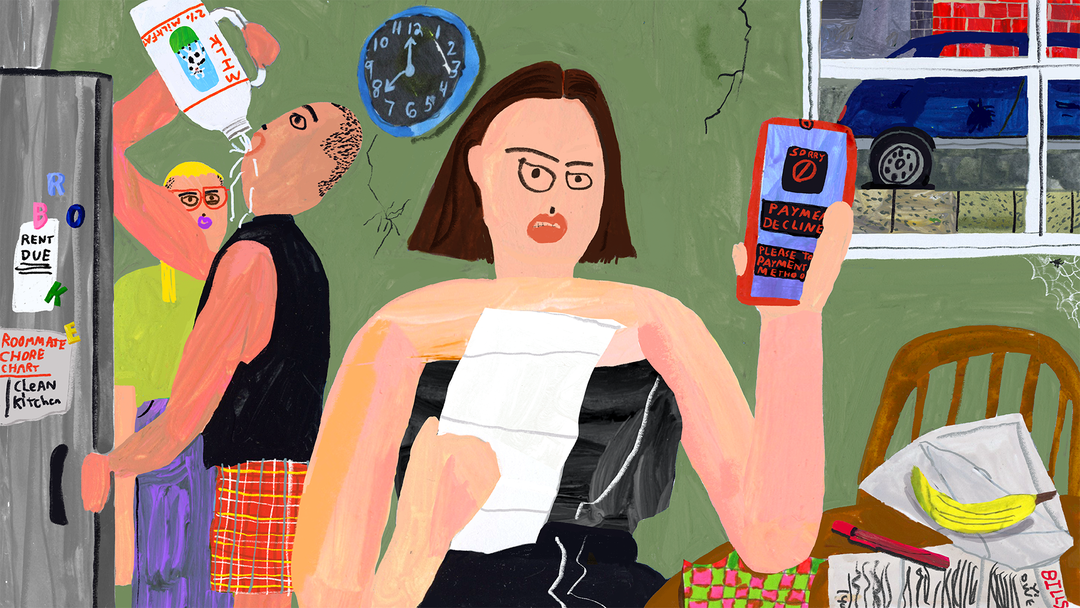
Not everyone can leave a salaried job simply because it no longer feels like the fullest expression of their soul. People have rent, children, debt, caring responsibilities and families who cannot support them if things go wrong. Even the ability to imagine another kind of life can depend on whether you have ever seen somebody like you living one. It took me 31 years to realise the life I wanted might be possible.
I do not think the answer is to romanticise precarity or pretend that fear is the only thing standing between every unhappy creative and artistic freedom. Sometimes the obstacle is not confidence. Sometimes it is £10,000.
But I do think we should make changing direction feel less like failure. We should be able to admit that a path no longer fits without pretending it was worthless. A career can have been right for you once and wrong for you now. You can have worked hard to enter a room and still be allowed to leave it.
For a long time, I thought becoming myself would require rejecting everything I had been. I don’t think that’s true anymore. Sometimes the first creative path you take is not your final destination, but your training ground. It gives you tools before you know what you want to build with them.
Maybe design is your thing. If it is, I hope you love it. I hope you stay, make beautiful work and get paid properly. But if it isn’t, that’s okay too. You are allowed to leave without declaring the whole building evil. You are allowed to be grateful and furious. You are allowed to acknowledge that a place formed you without agreeing to remain there forever.
Design was not the wrong place for me. It was the place before the place.
“I do not think the answer is to romanticise precarity or pretend that fear is the only thing standing between every unhappy creative and artistic freedom.”
Harriet Richardson
As I arrive at the Bill Murray for my tech rehearsal, which I’d later discover is a stone’s throw from Pentagram’s new offices, I stand beside the projector while the technician tilts his head at the screen.
“Does that look all right, Harriet? I can’t seem to get it to – ”
“Make it green and move it left,” I say, without a second thought.
And as I perform my hour of stand-up comedy in front of a screen that is an unusual shade of turquoise and slightly too far to the left, I am assured that I am exactly where I’m meant to be. John Rushworth, thank you for never firing me. I hope you make it to my show one day.
Hero Header
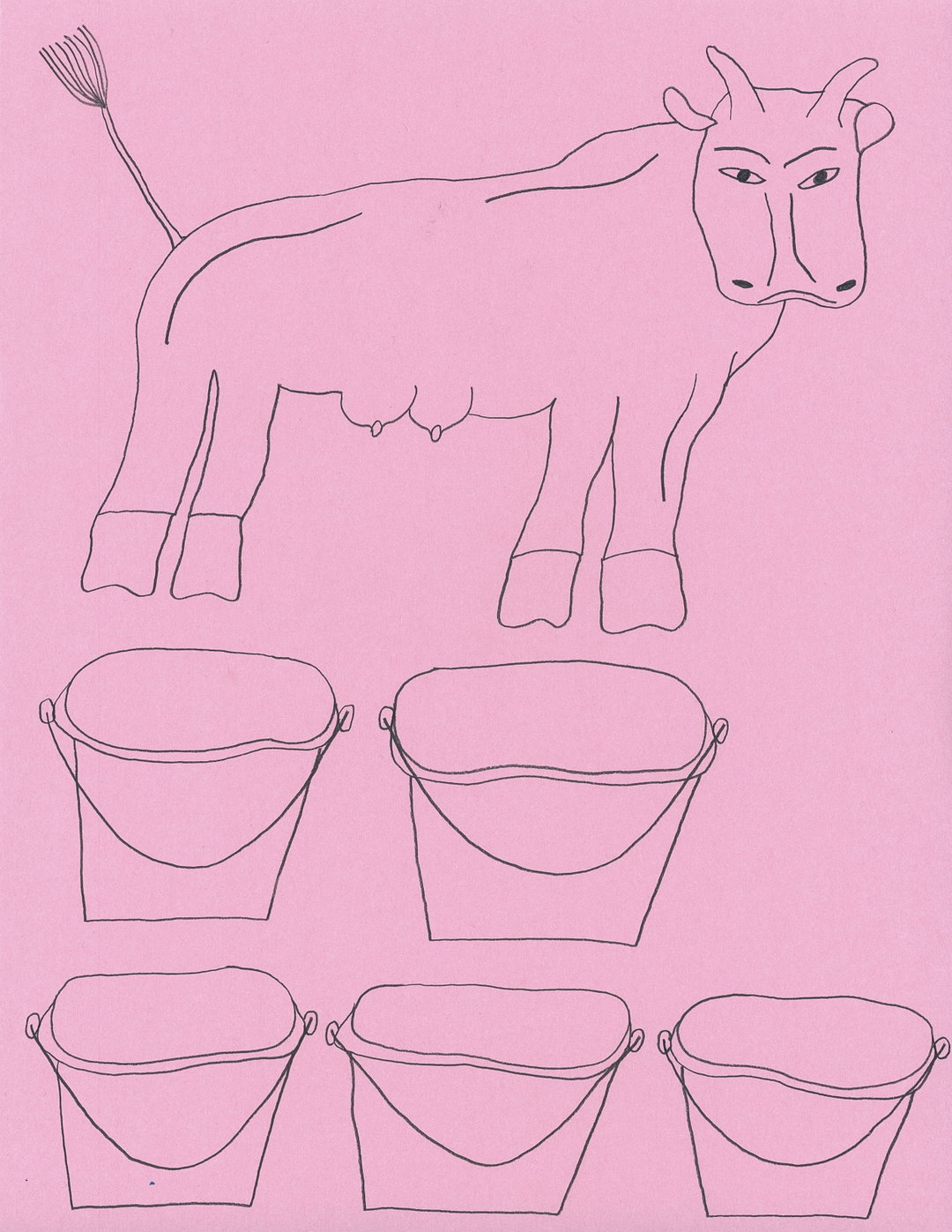
Tara Booth for It’s Nice That (Copyright Tara Booth / It’s Nice That, 2026)
Share Article
Further Info
Harriet is performing CREEP at Edinburgh Fringe, 5-30 August.
About the Author
—
Harriet Richardson is a writer and performance artist whose work spans live performance, confessional writing, and visual practice, often exploring intimacy, desire, and addiction. Her recent and forthcoming projects include 100 Dates, and Temporary. She debuted at the Edinburgh Fringe in 2026 and is currently writing her first book.