

- Words
- Arman Khan
- —
- Date
- 6 May 2026
- Tags
Benjamin Tuttle spent years designing for a Brooklyn microcinema – it all led him to Netflix’s Beef
The typeface and graphic designer breaks down his process and historical reference points for creating the second season titles of A24’s hit show.
Share
Share
In 2019, the designer Benjamin Tuttle was approached by his friend, the multidisciplinary artist Shira Inbar, to contribute to her project: Separated-Separados. All the illustrations, from various artists, dealt with the separation of migrant children from their families and the atrocious border security practices by the Trump administration. Benjamin took the design brief up a notch. If anything needed to be separated, he joked, it should be the ICE agents. He illustrated one being literally pulled apart, split in two from the middle, all his gnarly insides stretched out like a satisfying cheese pull off a pizza. A solitary line ran horizontally at the bottom: “We are separating the wrong people.”
“It is sad that something I drew seven years ago is still relevant.”
Benjamin Tuttle
It didn’t make it to the publication, but is immortalised on Benjamin’s Instagram, just three posts after his post on the process of designing the letters and type for A24 and Netflix’s Beef. “Earlier this year, I updated the colours and shared a link for people to download and print it,” he tells It’s Nice That. “It is sad that something I drew seven years ago is still relevant.”
Across Benjamin’s work, the past and present come together in a way that’s not always intentional. The relevance, if any, only emerges later, like the ICE illustration. For the second season of Netflix’s Emmy-award-winning anthology, Beef, in which two couples spiral into blackmail and extortion at an elite California country club, Benjamin was commissioned to design the series title and episode lettering under the showrunner Lee Sung Jin’s creative direction. Benjamin’s canvas stretched all the way from Stanley Kubrick to Flemish punchcutters of the 18th century. “This season was set at a country club, so there was that upper-class setting, a certain genre of typeface that speaks to wealth, and we wanted to tap into that,” he says.
When Lee Sung Jin showed Benjamin some of the paintings that were going to be in the background of the episode titles, it was all the reason Benjamin needed to collapse various time periods in the lettering. A lot of the paintings were Dutch, Flemish, Belgian, from the late Renaissance and Baroque period. “I love the type from that time and that region,” he says. “So, I tried to steer the ship in that direction.”
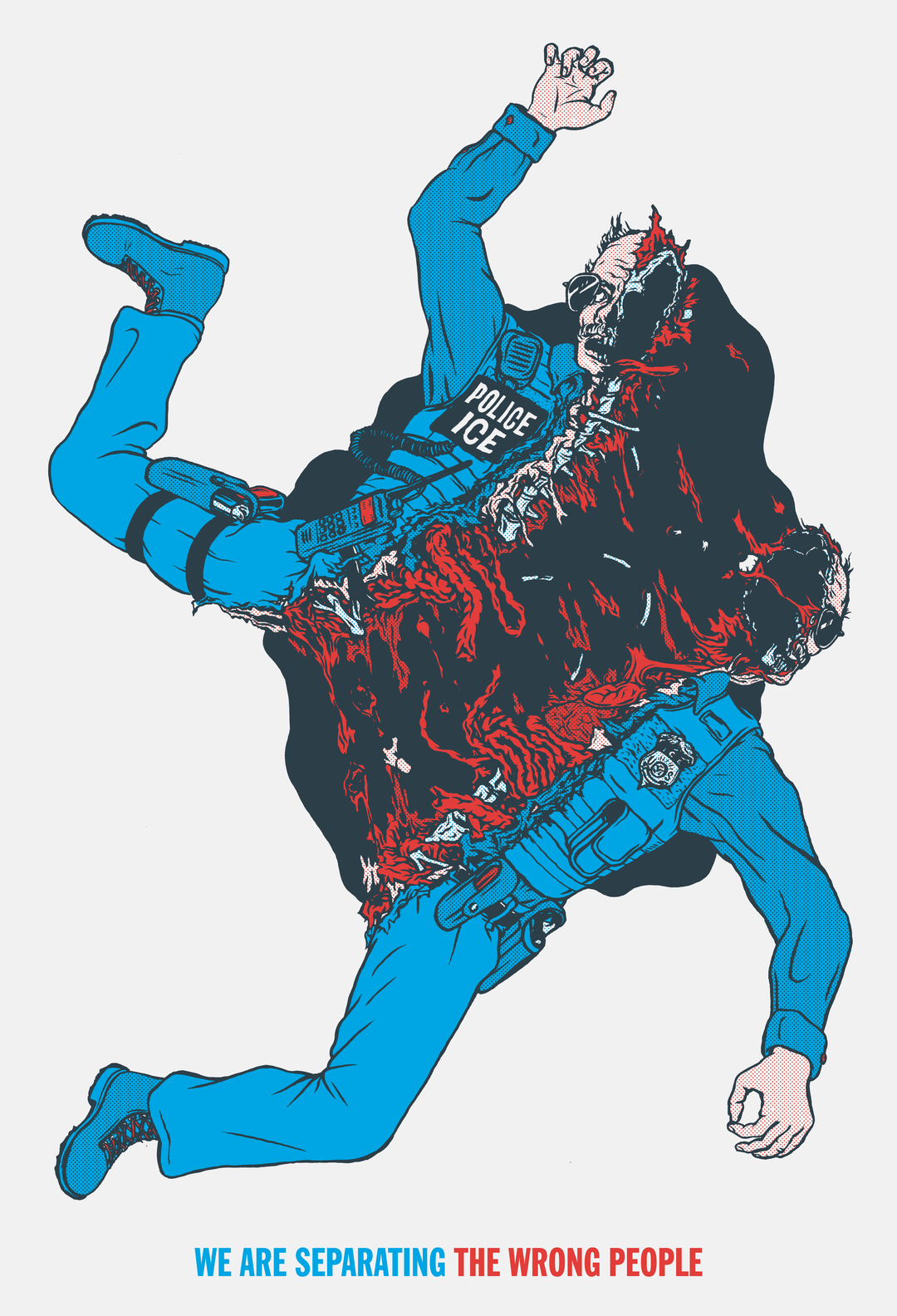
Benjamin Tuttle: Fuck Ice, 2019
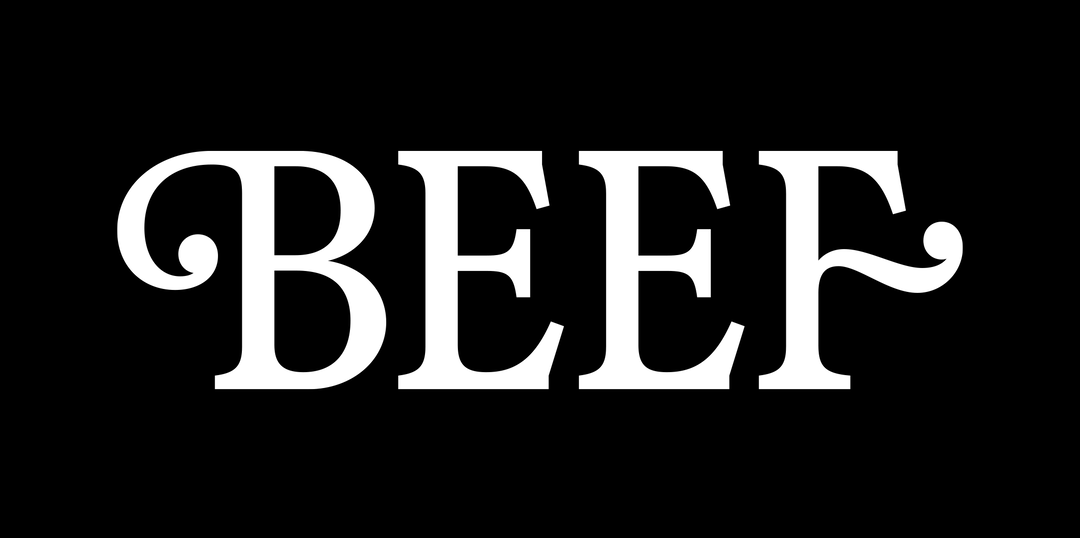
Benjamin Tuttle: typeface design for Beef; creative director Lee Sung Jin (Copyright © A24)
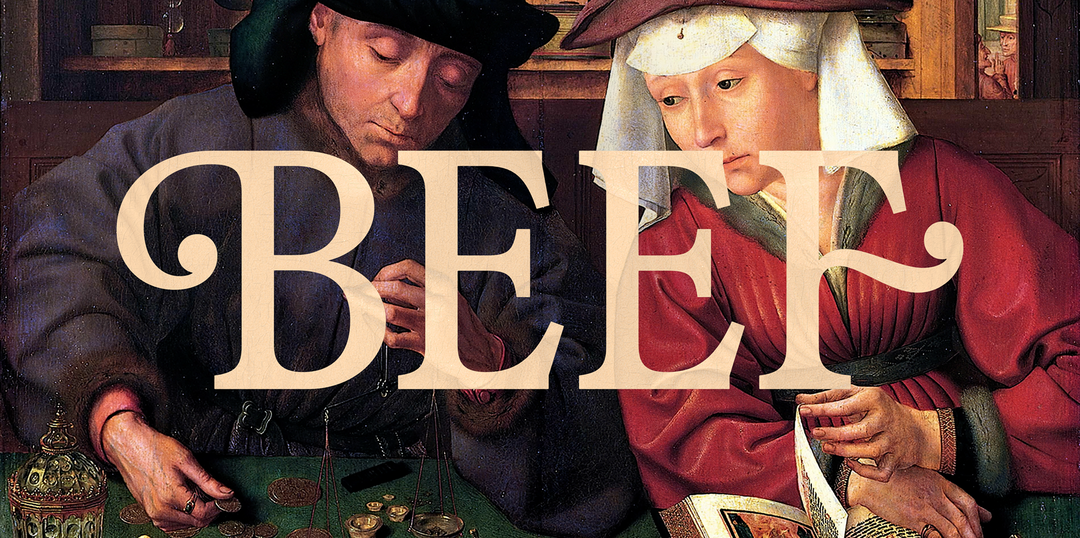
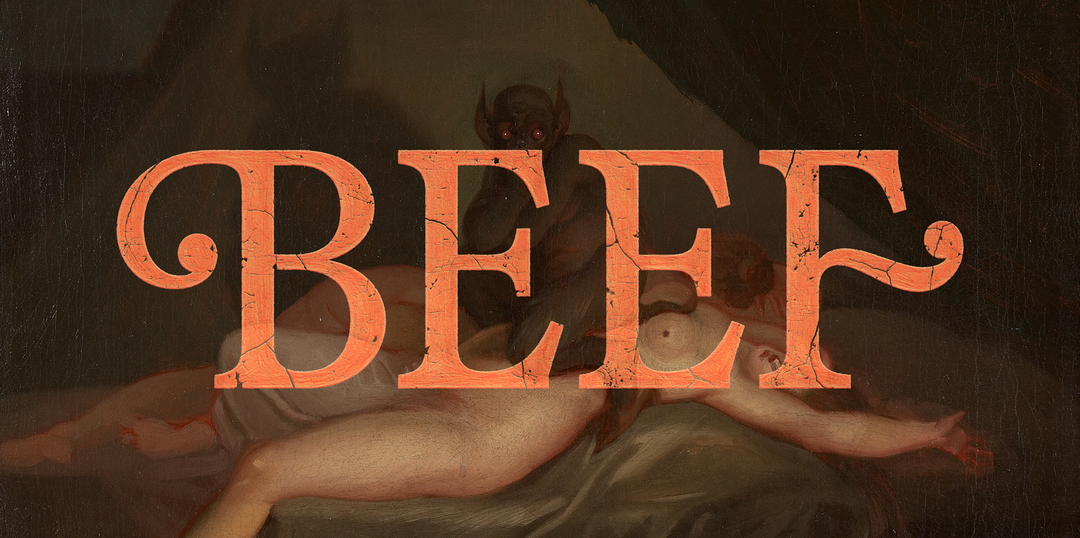
In season two, the ball terminal of ‘B’ in Beef has a bougie personality, mirroring the posh characters traipsing around Monte Vista Point, unlike the bold, vertical font of the first season. The type seems almost wounded, or just about getting there. But it’s really the result of various time periods layered on top of each other. Right from the start, Benjamin and the team knew they would have decorative capitals. In the early process sketches, there is a flourish on practically every variation of ‘BEEF’.
“We took the flourish from Bill Gold’s lettering for Kubrick’s Barry Lyndon, then I incorporated a few moments from the 18th-century punchcutter Jacques François Rosart’s work, specifically, the way certain serifs are treated,” he says. “But we also wanted immediacy. A lot of the Rosart material I was looking at was very high contrast; the thick-thin relationship was quite extreme. I also started looking at newspaper typefaces, such as Monotype Plantin – lower contrast, blunter, greater immediacy.”
Bookman briefly crossed Benjamin’s mind, too, because of all those swashes, but he didn’t want the show’s lettering to feel cheap, like the plastic thank-you bags in American shops that are mostly set in Bookman. The type inspiration from 18th-century punchcutters such as Rosart mirrors the wealthy characters in the show, too. After all, as Benjamin says, “type founding was predominantly an upper-class vocation, with early punchcutters coming from goldsmithing backgrounds”.
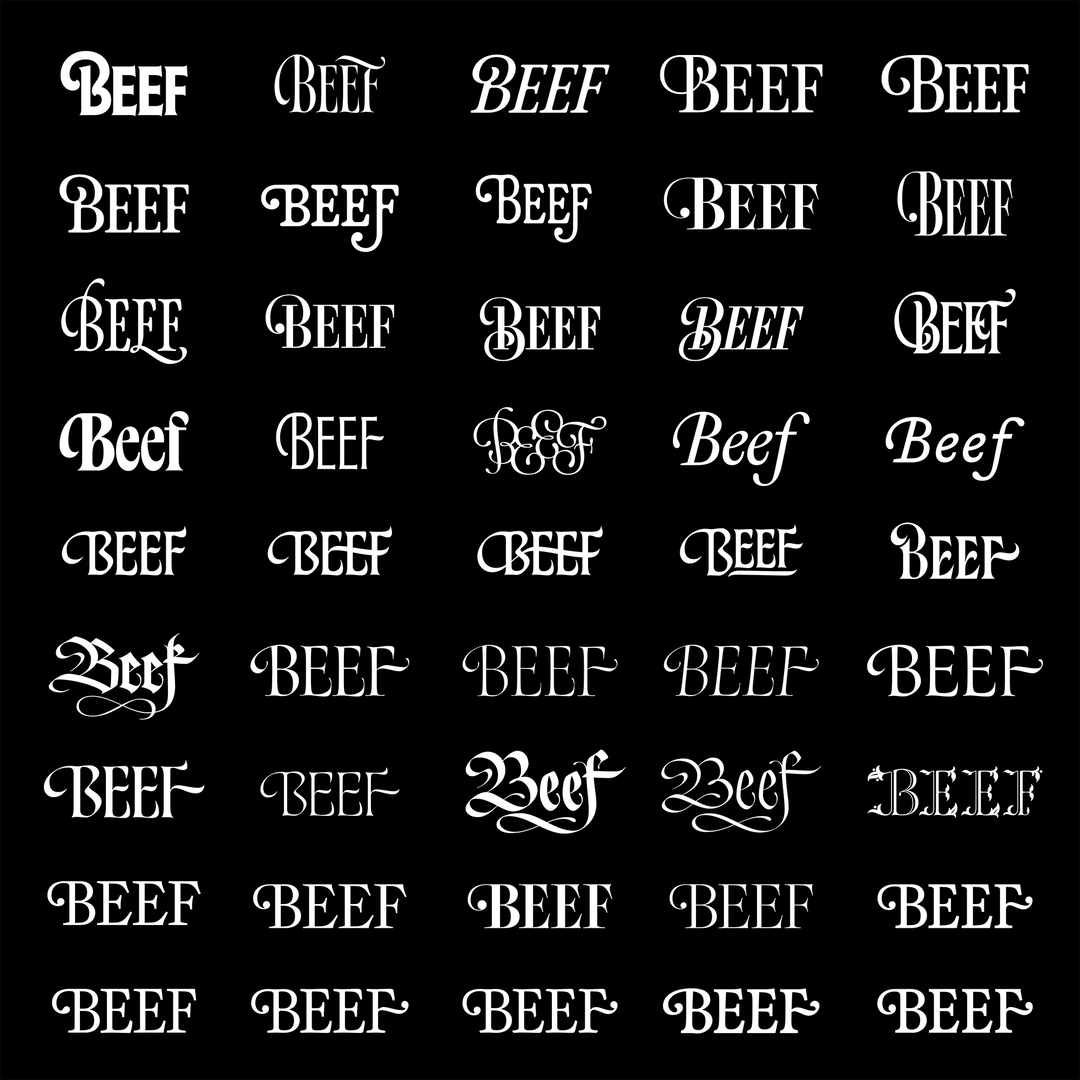
Benjamin Tuttle: typeface design explorations for Beef; creative director Lee Sung Jin (Copyright © Benjamin Tuttle)
Benjamin Tuttle: typeface design explorations for Beef; creative director Lee Sung Jin (Copyright © Benjamin Tuttle)
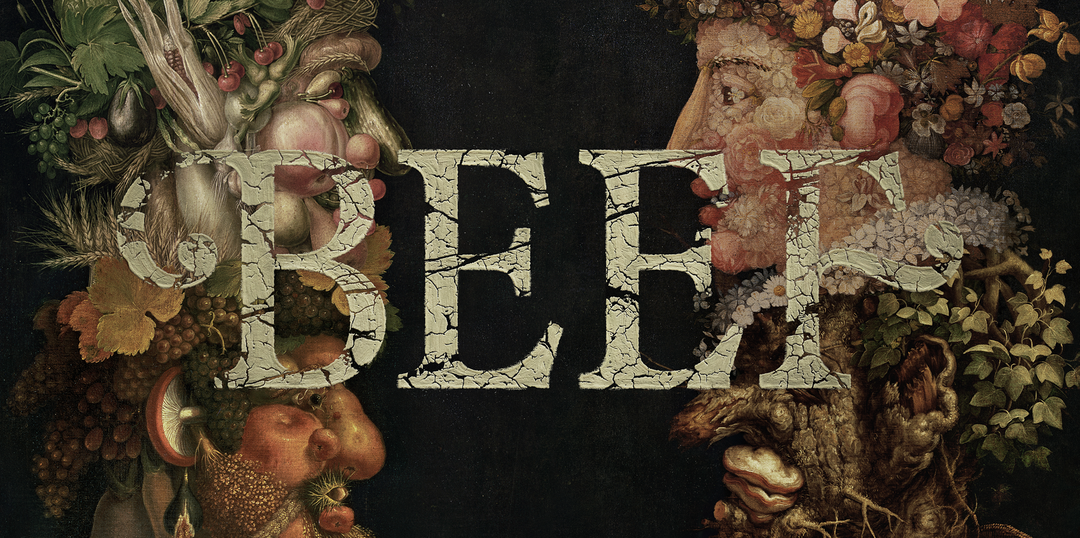
Benjamin Tuttle: typeface design for Beef; creative director Lee Sung Jin (Copyright © A24)
Painting: The Four Seasons by Giuseppe Arcimboldo, 1563, 1572, 1573, digitally collaged by Vandivision
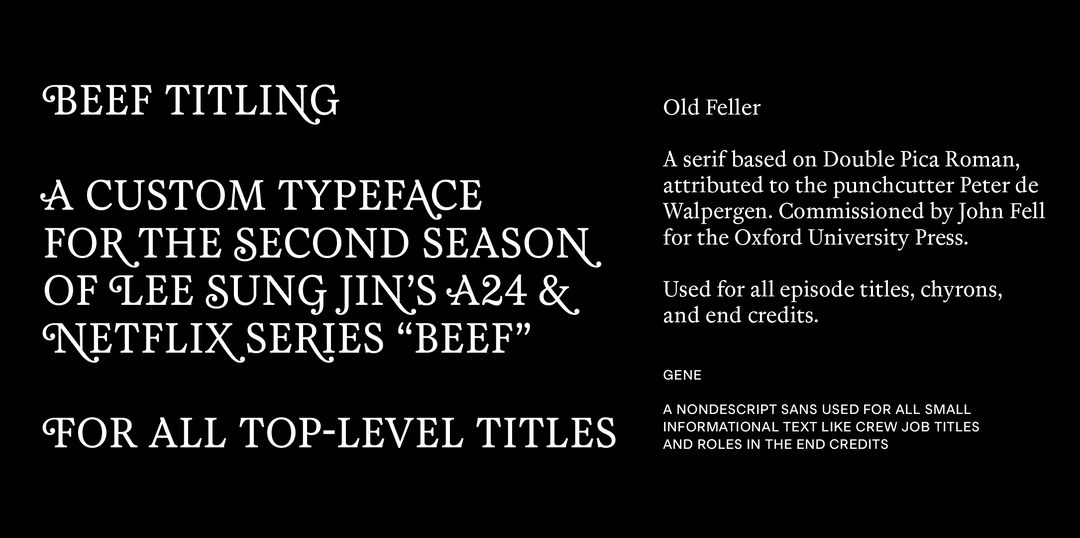
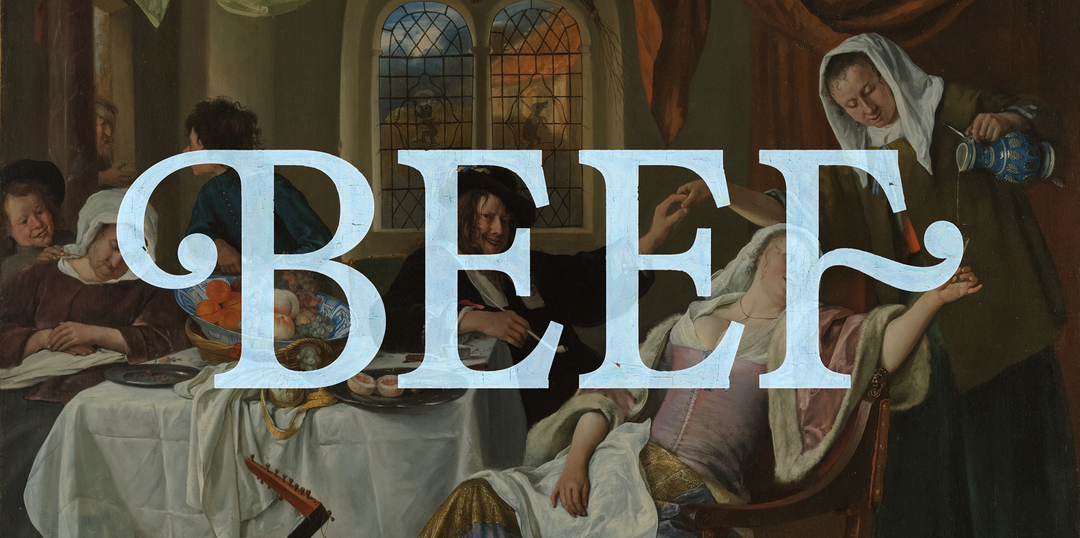
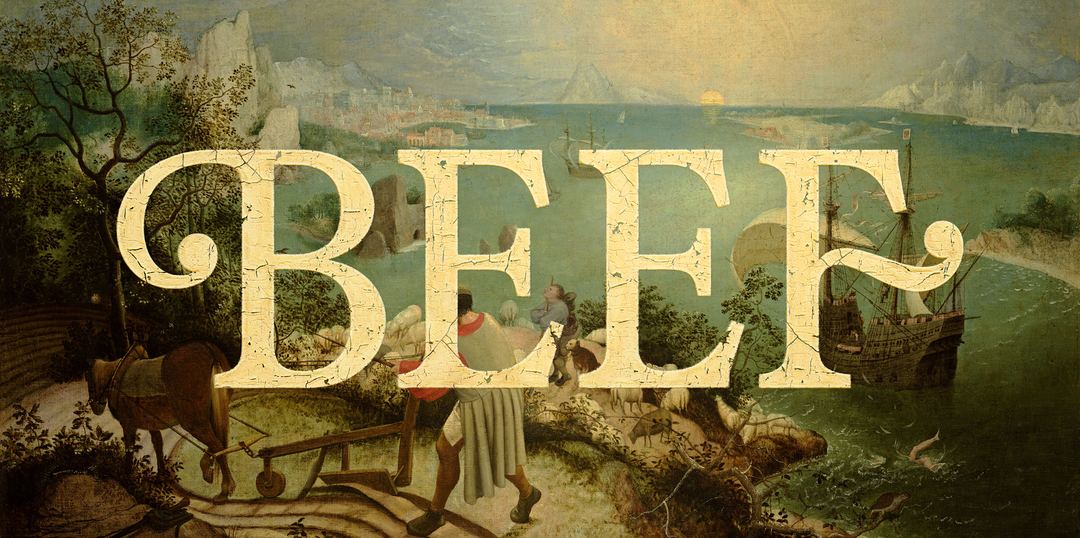
The font for the episode titles – which appear on the various grotesque European paintings showing the vulgarity of the human body and wealth – Benjamin calls it Old Feller, a revival based on Double Pica Roman, predominantly attributed to a punchcutter named Peter de Walpergen, who cut it in England for John Fell. Fell had gone to the Netherlands and Belgium, bought up a collection of the type and brought it back to Oxford University Press. “So, there is this interesting throughline, Dutch to England, and you can see the DNA running from one to the other,” Benjamin says. “That movement between countries also felt like a parallel to what was happening in the show: characters and capital moving between California and South Korea. Lee Sung Jin’s choice of European paintings just broadened the visual metaphor.”
“There was that upper-class setting, a certain genre of typeface that speaks to wealth, and we wanted to tap into that.”
Benjamin Tuttle
1 of 6
Benjamin Tuttle: typeface design for Beef; creative director Lee Sung Jin (Copyright © A24)
Painting: The Dissolute Household by Jan Steen, c. 1663–1664
1 of 6
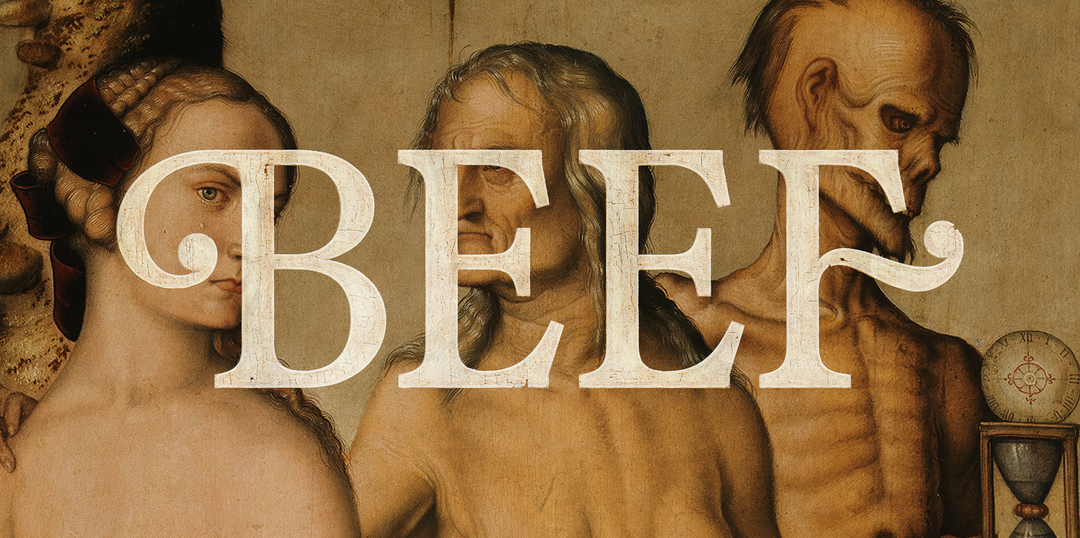
Benjamin Tuttle: typeface design for Beef; creative director Lee Sung Jin (Copyright © A24)
Painting: The Dissolute Household by Jan Steen, c. 1663–1664
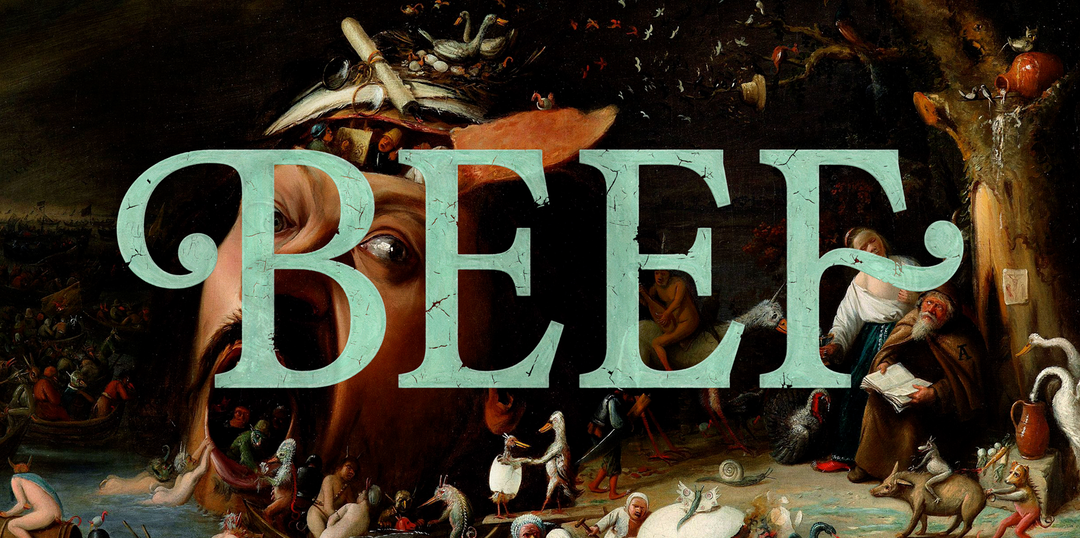
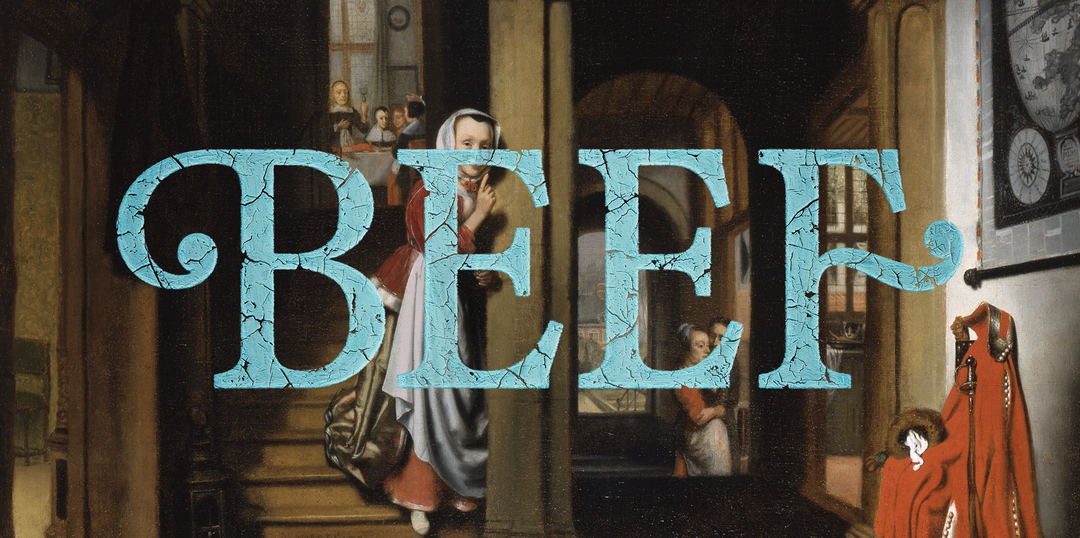
Even after Benjamin had designed the episode titles, the journey of the typeforms had only begun. Lee Sung Jin wanted the episode titles to appear deteriorated and cracked, almost like parched earth, with every passing episode. Because the episode titles were appearing on different paintings, the texture of the deterioration of the type needed to feel like it was part of the paintings. “Dylan Vanderberg and the Vandivision team handled the texture treatment magnificently. They worked very closely with Lee Sung Jin, who is detail-oriented – he will place a crack on the letter exactly where he wants it. My contribution was mostly the shapes of the letters, and working with him to make sure each episode was more distressed than the last, with episode eight being the most deteriorated, barely legible.”
Benjamin Tuttle: typeface design for Beef; creative director Lee Sung Jin (Copyright © A24)
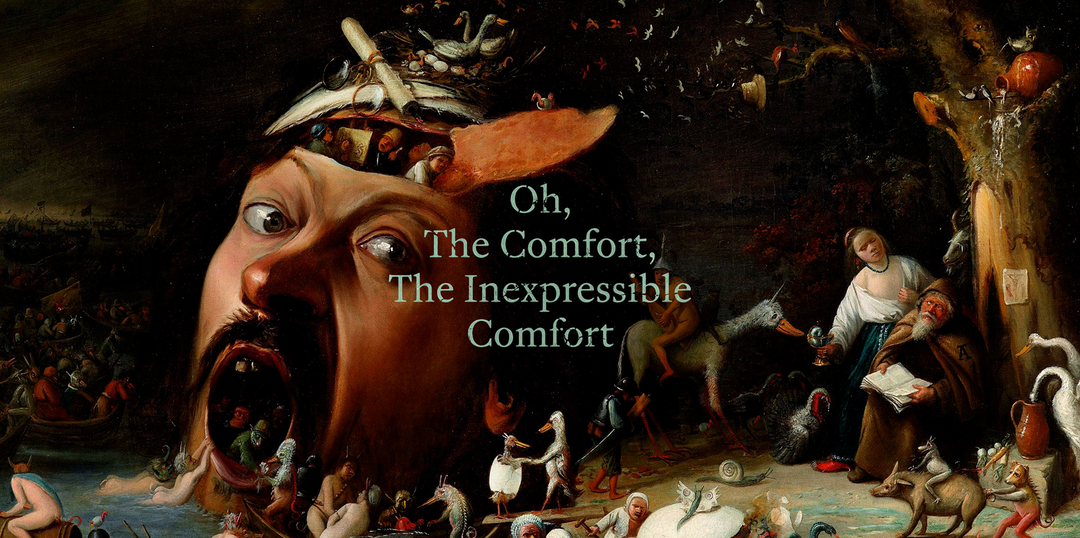
Painting: The Temptation of Saint Anthony by Joos van Craesbeeck, 1650
Benjamin Tuttle: typeface design for Beef; creative director Lee Sung Jin (Copyright © A24)
Painting: The Eavesdropper by Nicolaes Maes, 1657
Benjamin Tuttle: typeface design for Beef; creative director Lee Sung Jin (Copyright © A24)
Painting: The Temptation of Saint Anthony by Joos van Craesbeeck, 1650
Benjamin Tuttle: typeface design for Beef; creative director Lee Sung Jin (Copyright © A24)
Painting: The Eavesdropper by Nicolaes Maes, 1657
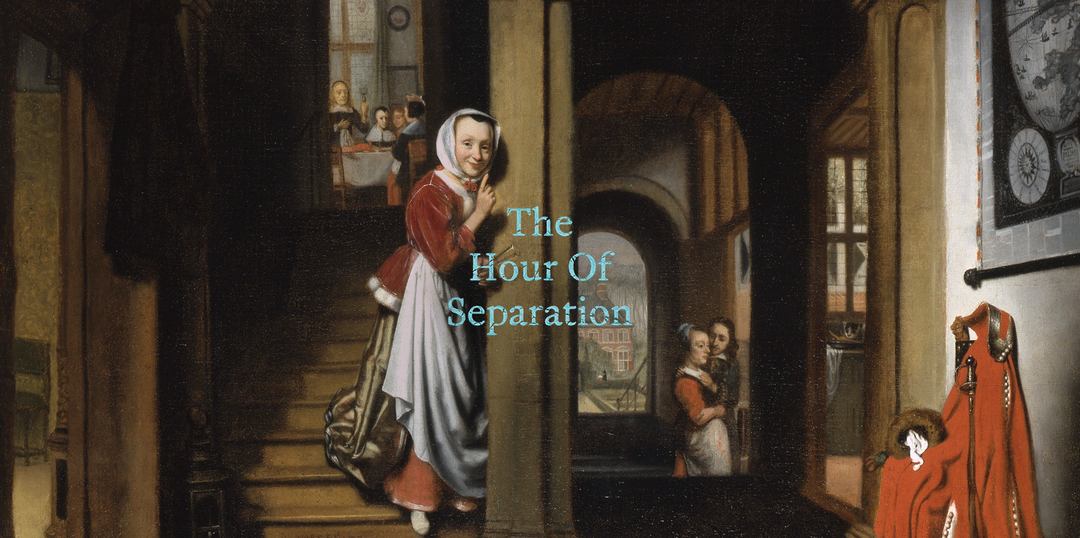
Benjamin Tuttle: typeface design for Beef; creative director Lee Sung Jin (Copyright © A24)
Painting: The Eavesdropper by Nicolaes Maes, 1657
“Lee Sung Jin is detail-oriented – he will place a crack on the letter exactly where he wants it.”
Benjamin Tuttle
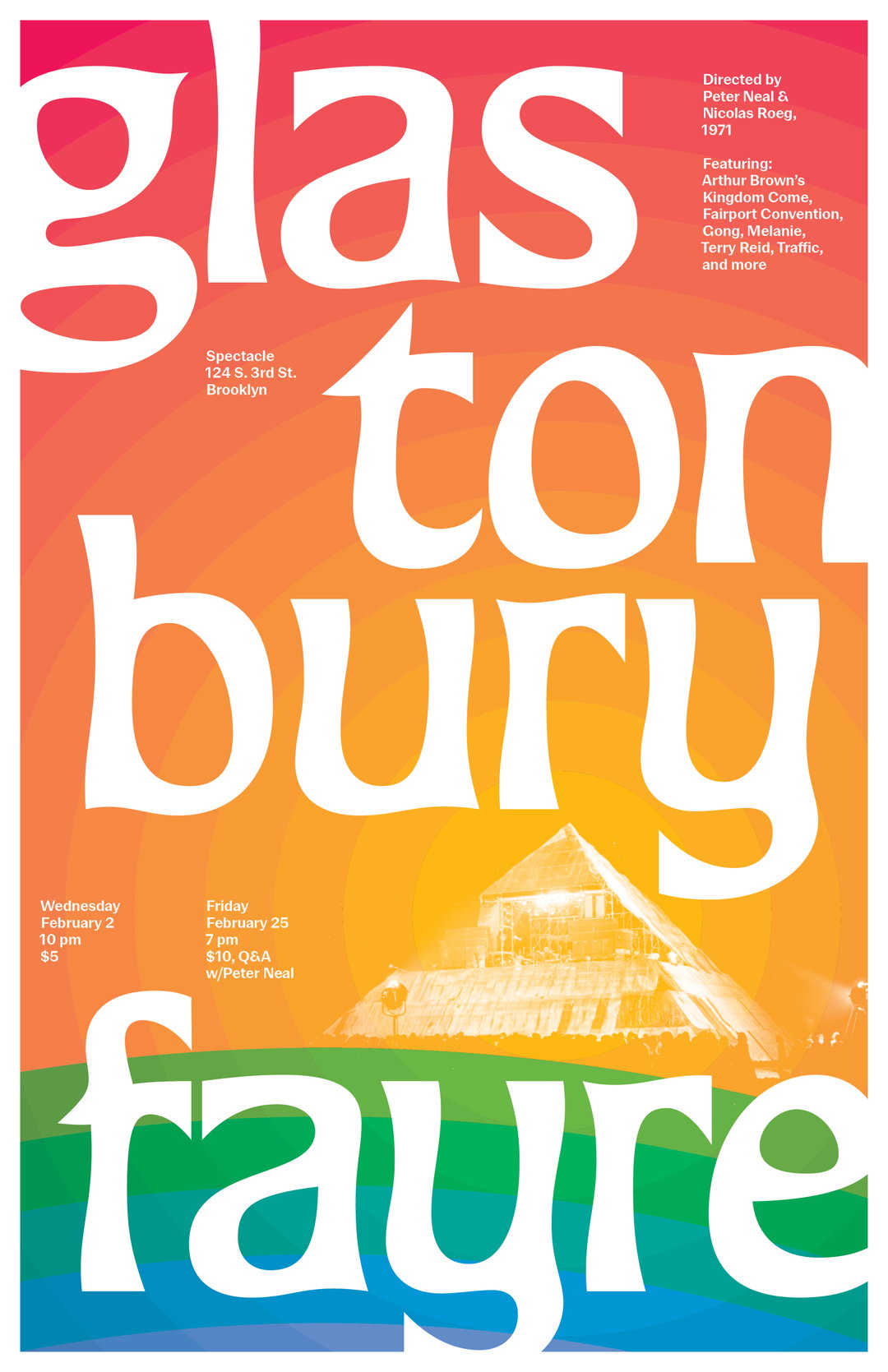
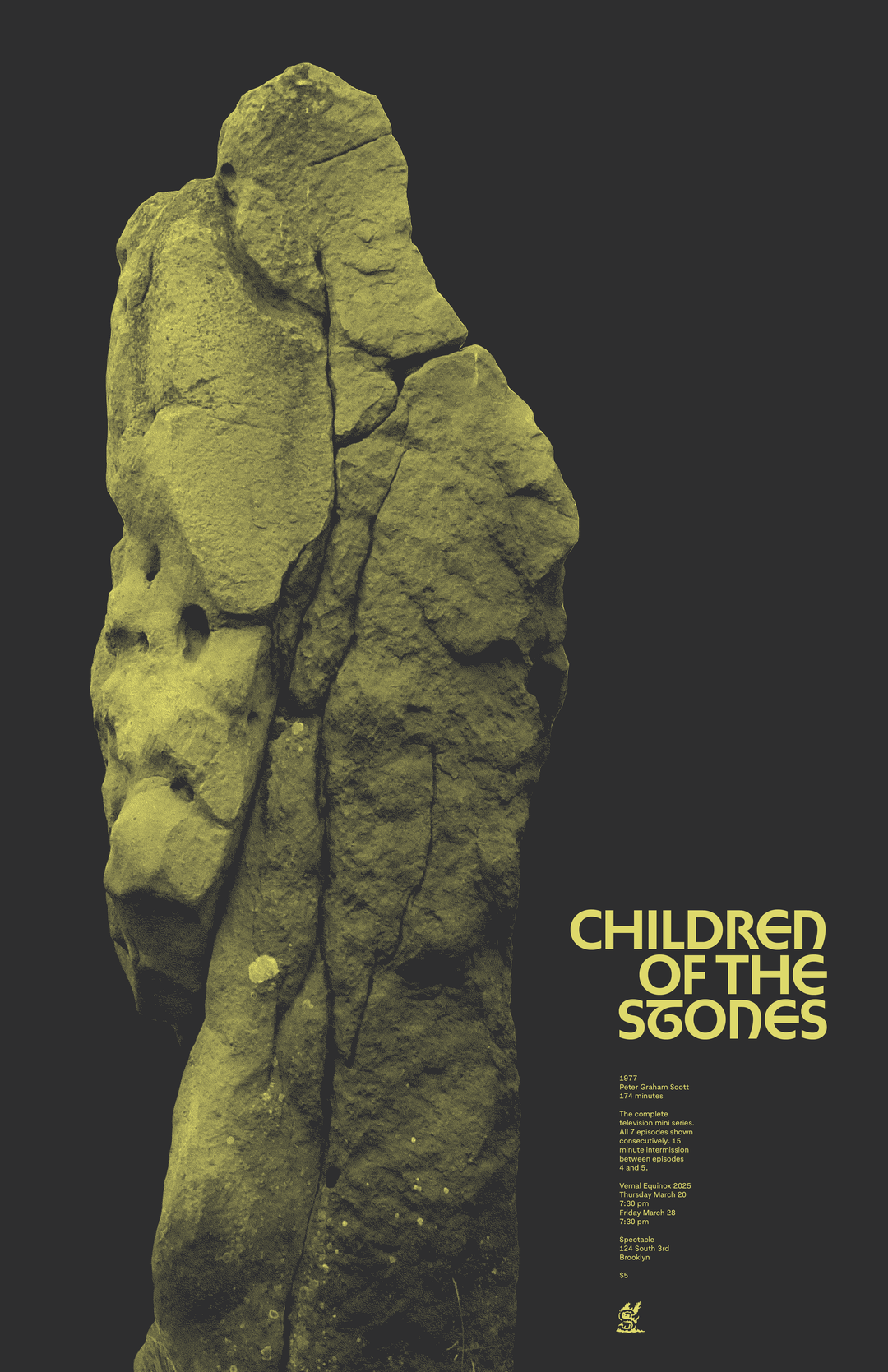
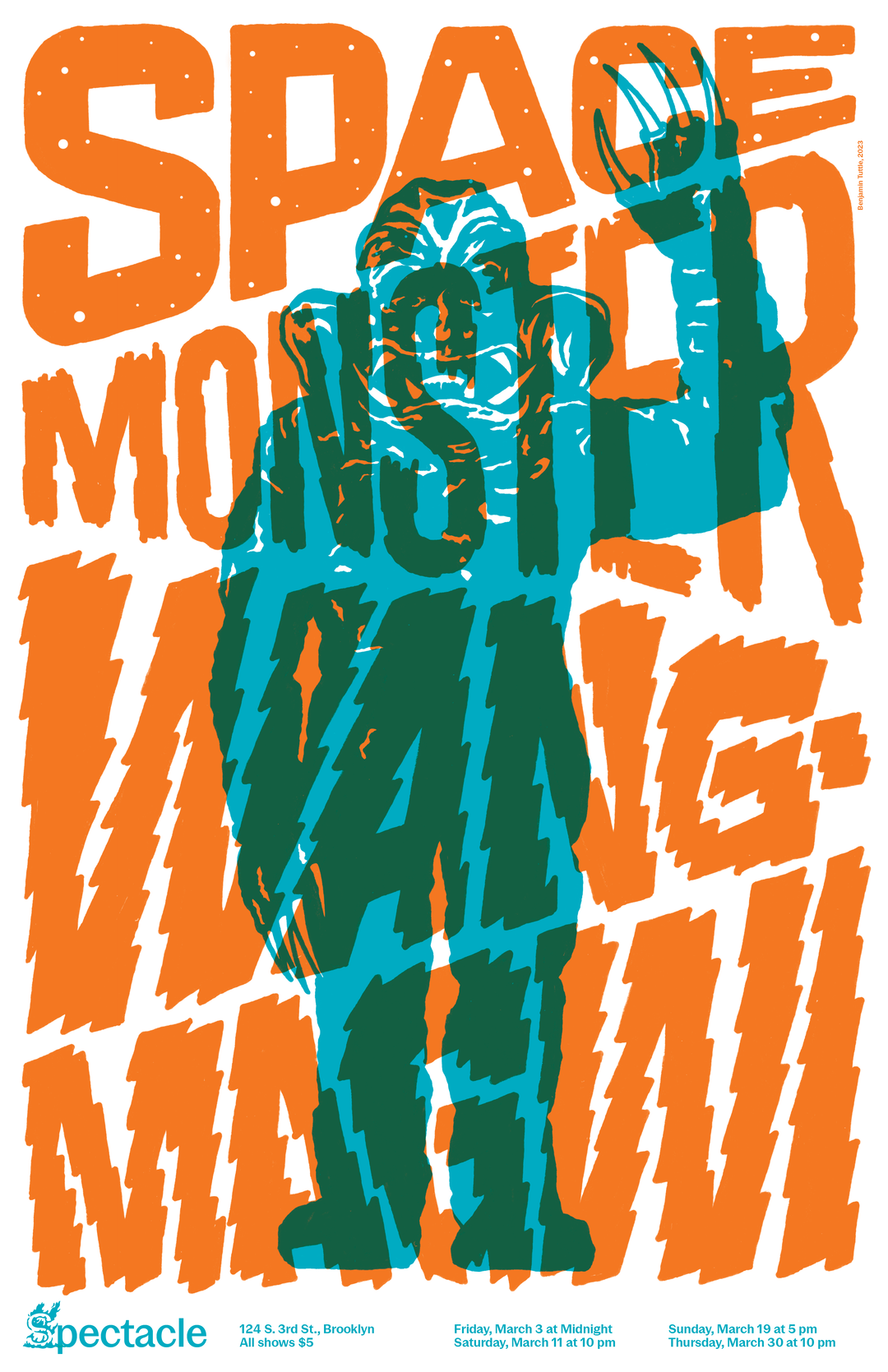
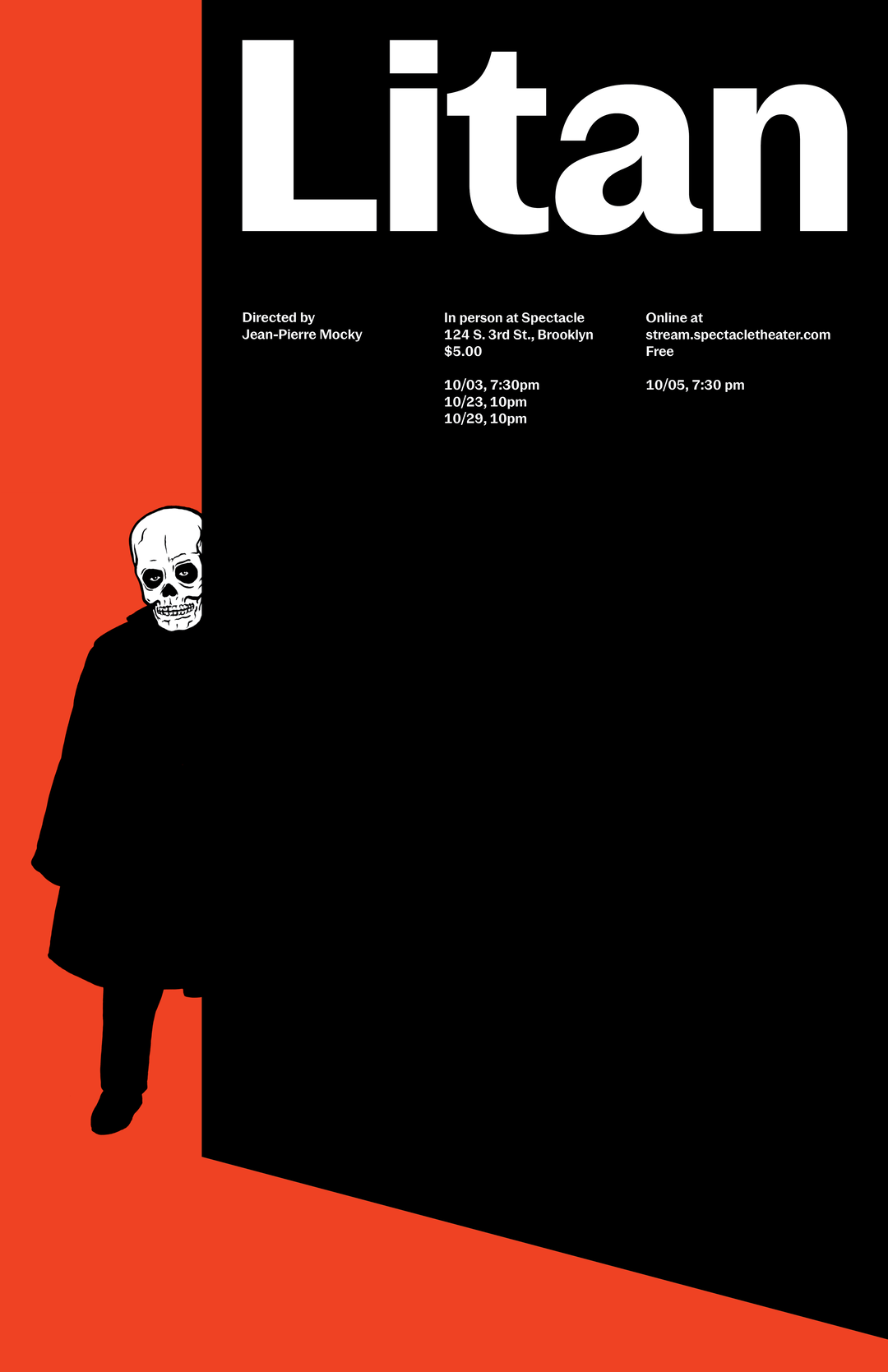
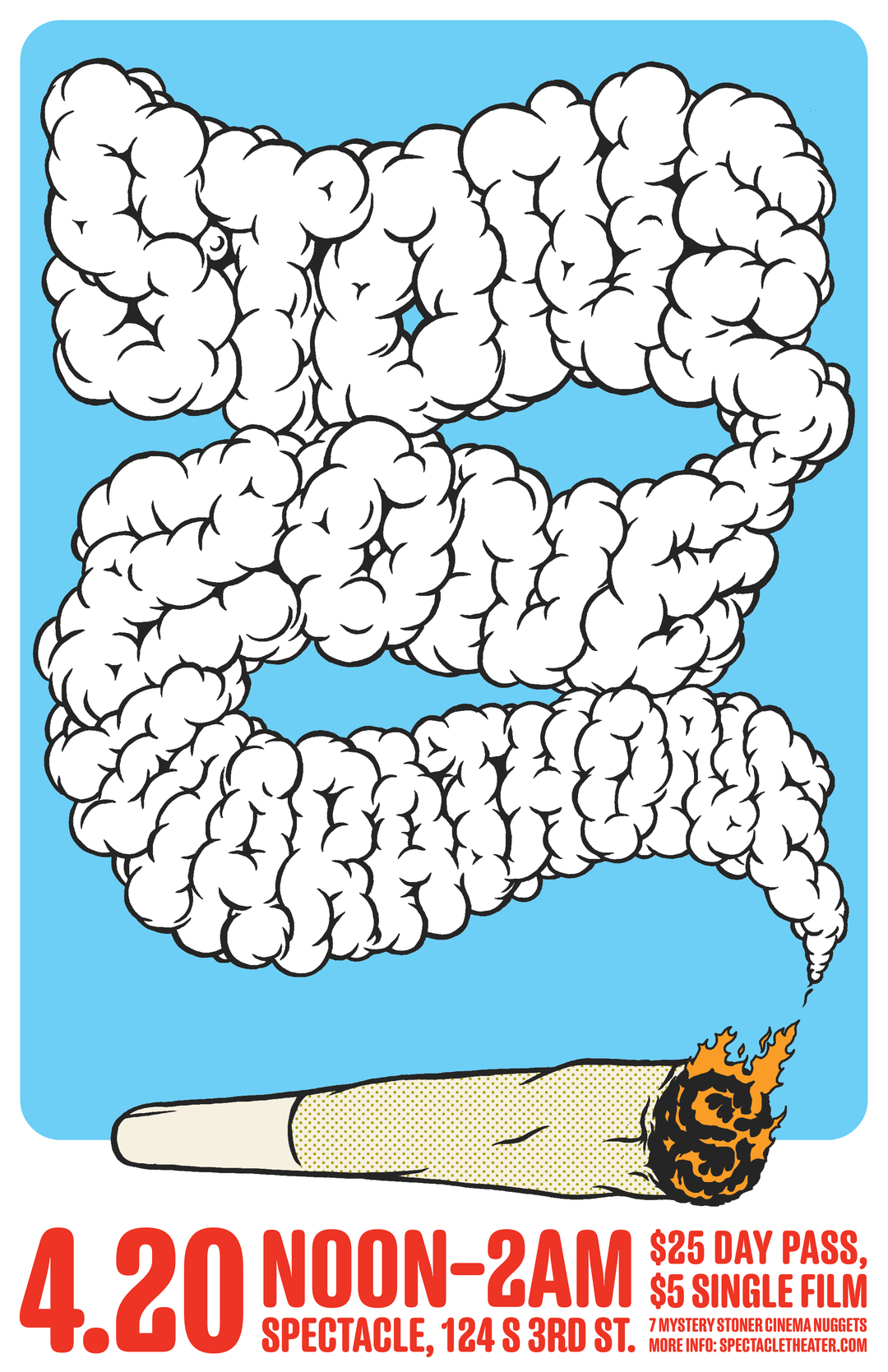
Benjamin’s contribution to the second season of Beef, with all its wild experimentations and leaps of inspiration, makes more sense when one looks at his poster work for Spectacle Theater: a Brooklyn microcinema that barely seats 35 people at a time, is fully run and operated by volunteers, with a ticket costing five dollars. New York is home to repertory cinema, and even within that space, Spectacle screens the most “weird and obscure stuff”.
“I credit Spectacle with saving my career because I had worked in-house at various graphic design jobs, constantly answering to bosses on weekends on fonts that weren’t even mine,” he says. For Spectacle, Benjamin would send a poster to the programmers and poster coordinators, and all he’d get back was an empathic ‘Thank you!’ It became a space to experiment, to work fast, and have fun. “Sometimes you find out about a screening a week beforehand, so you maybe have a weekend to get it done. There is no urgency in the usual sense because no one is getting paid. We are all volunteers,” he says.

Benjamin Tuttle: Spectacle poster for Frank Heath Wrong Number (Copyright © Benjamin Tuttle)
1 of 6
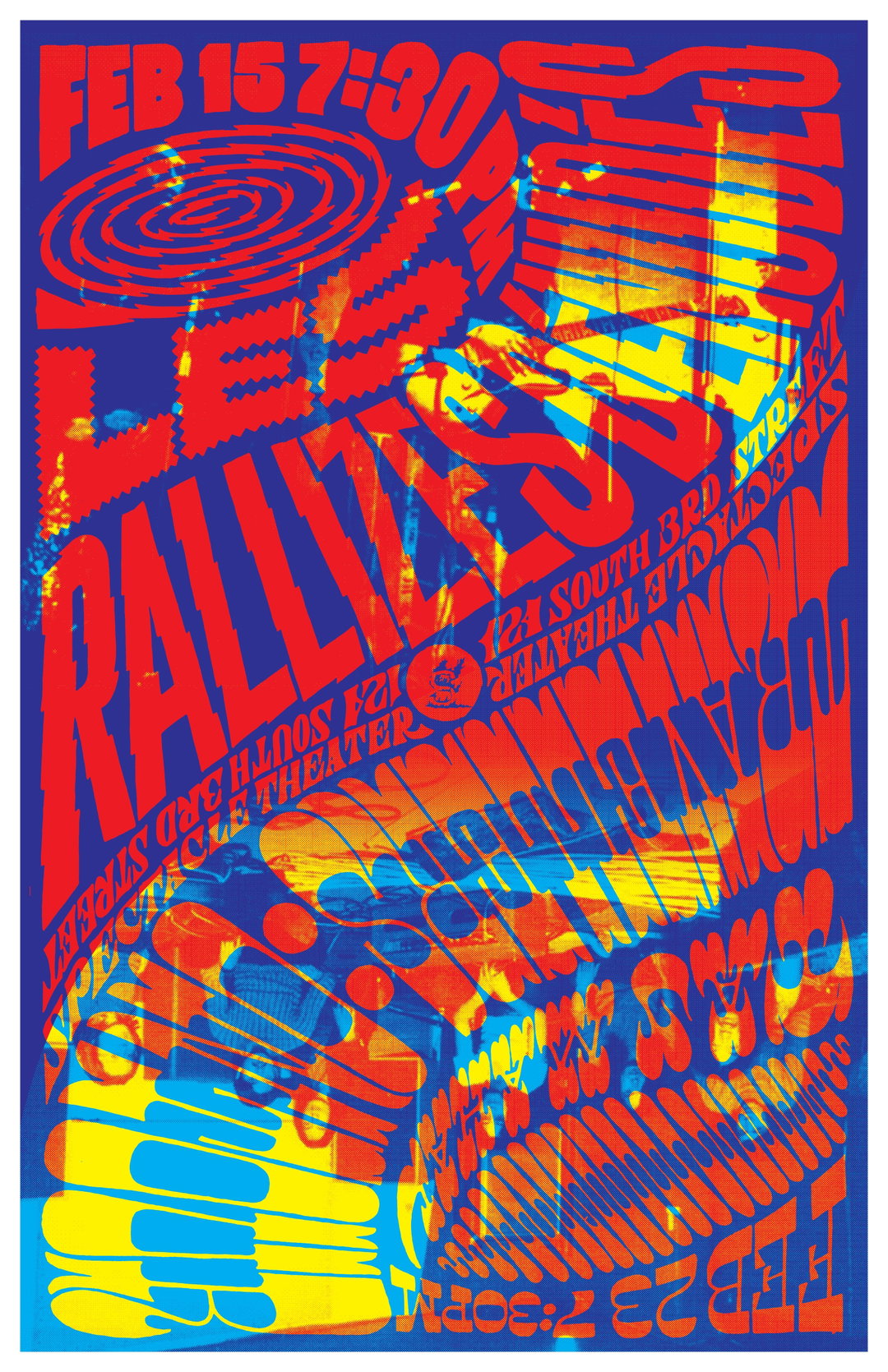
Benjamin Tuttle: Spectacle poster for Taj Mahal Travellers + Les Rallizes Denudes (Copyright © Benjamin Tuttle)
1 of 6
Benjamin Tuttle: Spectacle poster for Taj Mahal Travellers + Les Rallizes Denudes (Copyright © Benjamin Tuttle)
Consider Benjamin’s poster for a double bill of two concert films. The first on Taj Mahal Travellers, a Japanese experimental music ensemble founded in 1969, and the second on Les Rallizes Dénudés, a Japanese psychedelic noise rock band also from the late 60s. “The poster flips for which movie you want, one on each side; the text in the middle flips too. So, whatever movie is playing, that part faces up. I just drew that one day, scanned it in, threw the photos in there, and that was it.”
As erratic as the process sounds, there is order. The Taj Mahal Travellers’ side is more psychedelic, its letterforms bathed in acid. For the Les Rallizes Dénudés part, the shapes are electric; a tornado-like form reflects the cascading, droning music of the cult band. For the Spectacle poster of Action USA, the 1989 film by John Stewart, Benjamin edits out all the chaos and focuses on just one scene from the film: a car crashing dramatically through the roof of a house, the whole action scene depicted through a sequential narrative in a nine-square grid. In the first box, the house is normal, followed by other boxes where it is normal too, then the car enters the frame and goes up in flames in the final square. “Obviously, if a car drove into a house, the explosion would never be that big, but it certainly is in the over-the-top action movie,” he says. “I don’t get professional illustration work, so the posters are a place for me to work a muscle where I otherwise wouldn’t.”
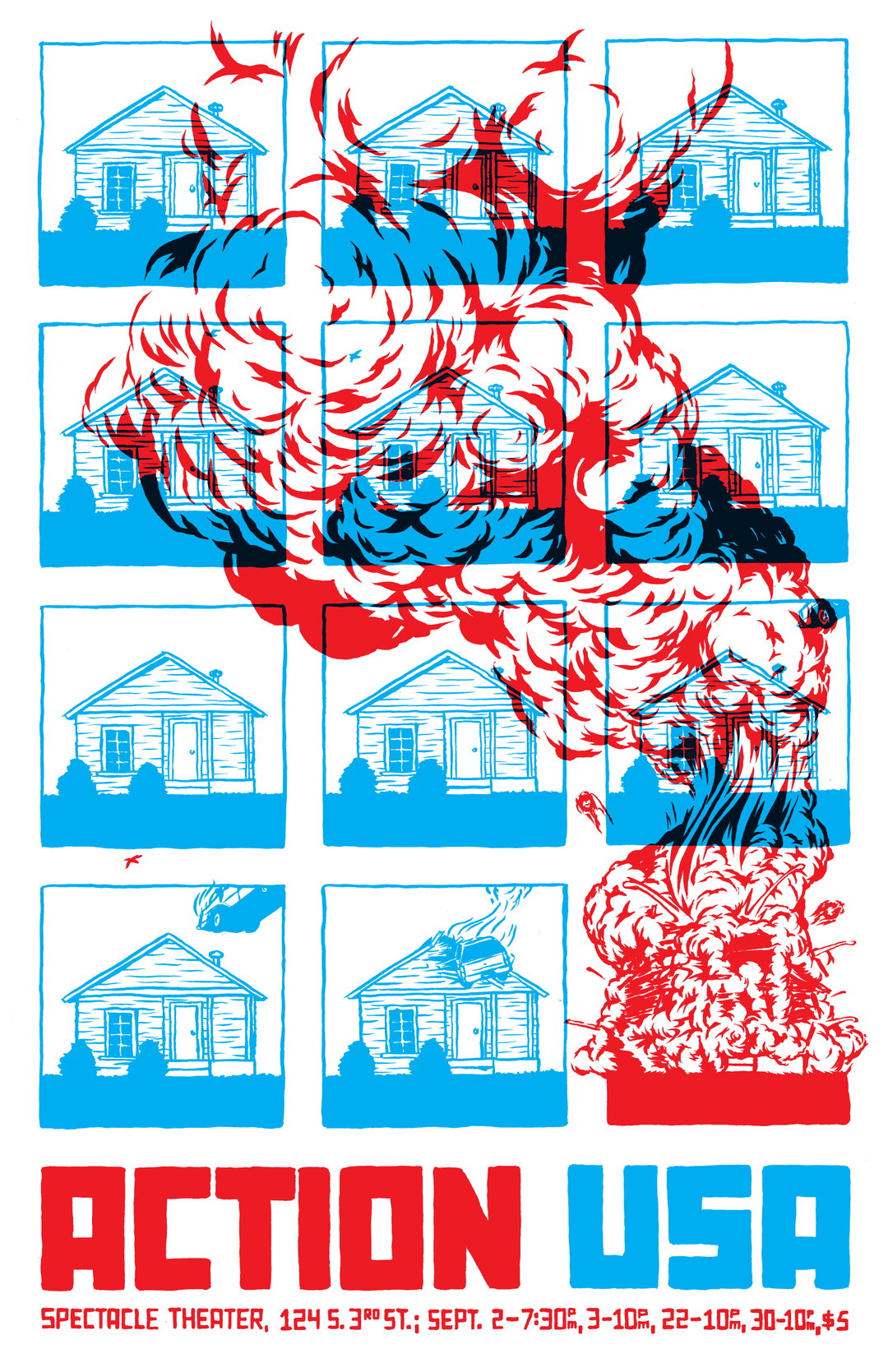
Benjamin Tuttle: Spectacle poster for Action USA (Copyright © Benjamin Tuttle)
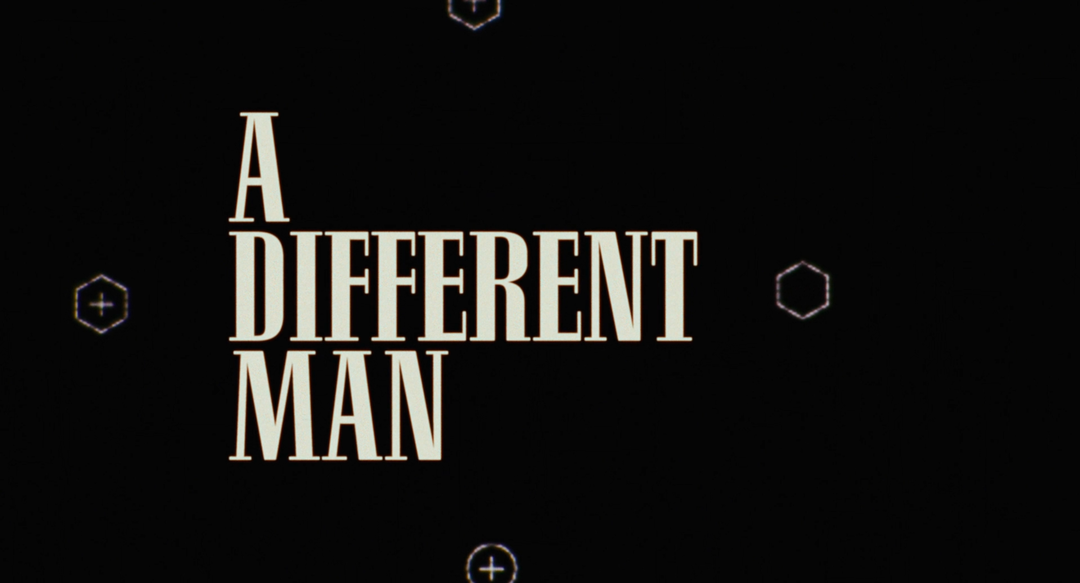
Benjamin Tuttle: Title design and layout for A Different Man titles (Copyright © Benjamin Tuttle)
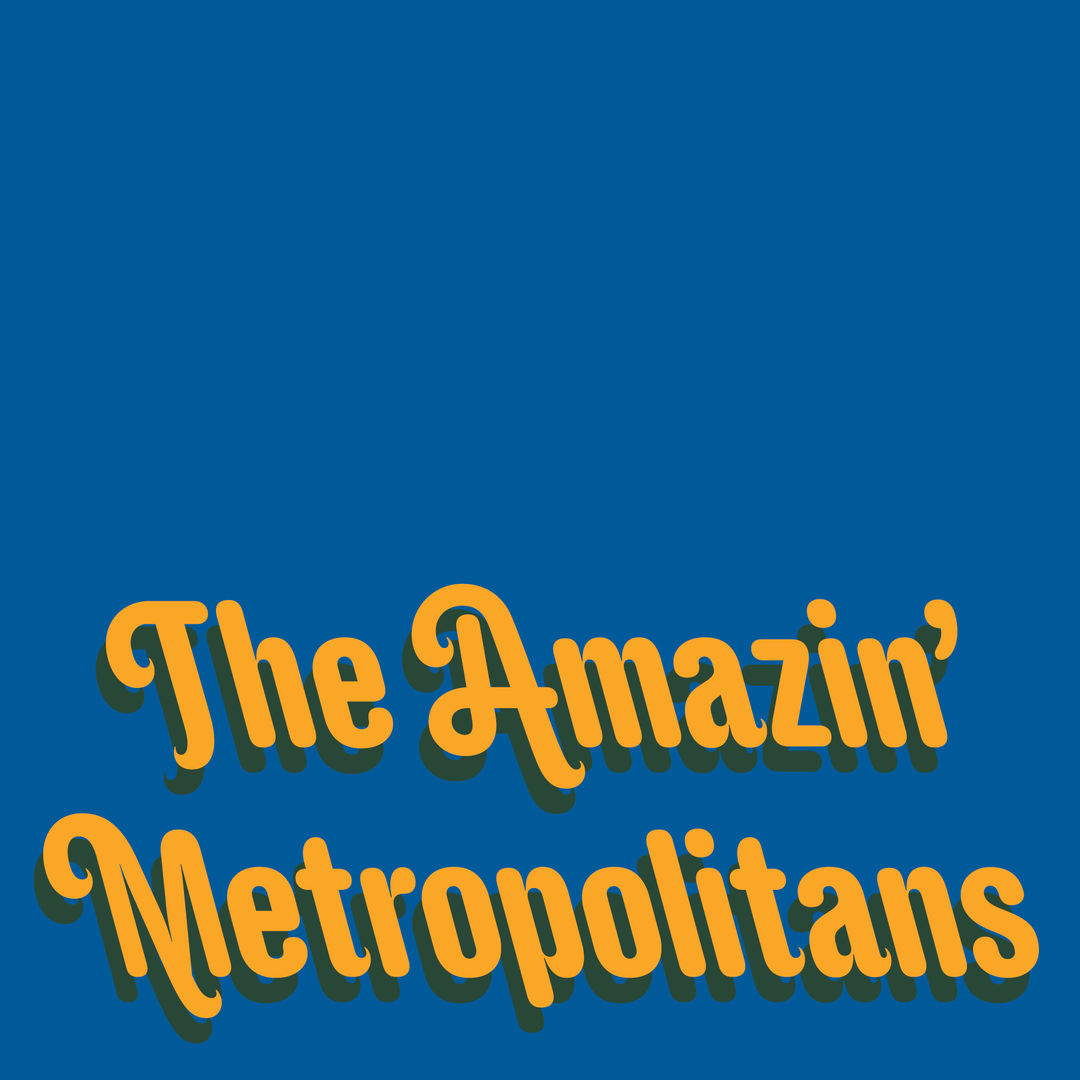
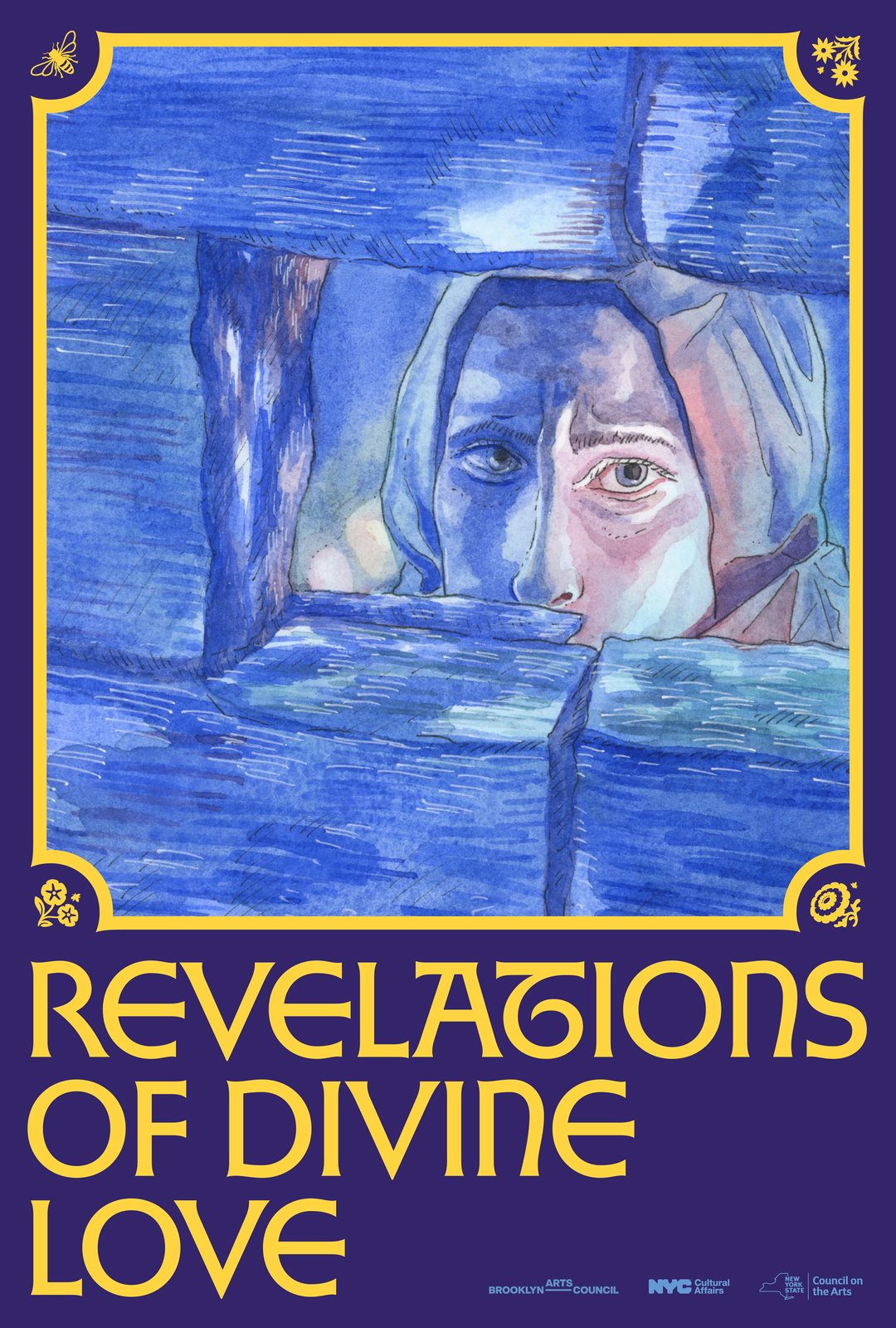
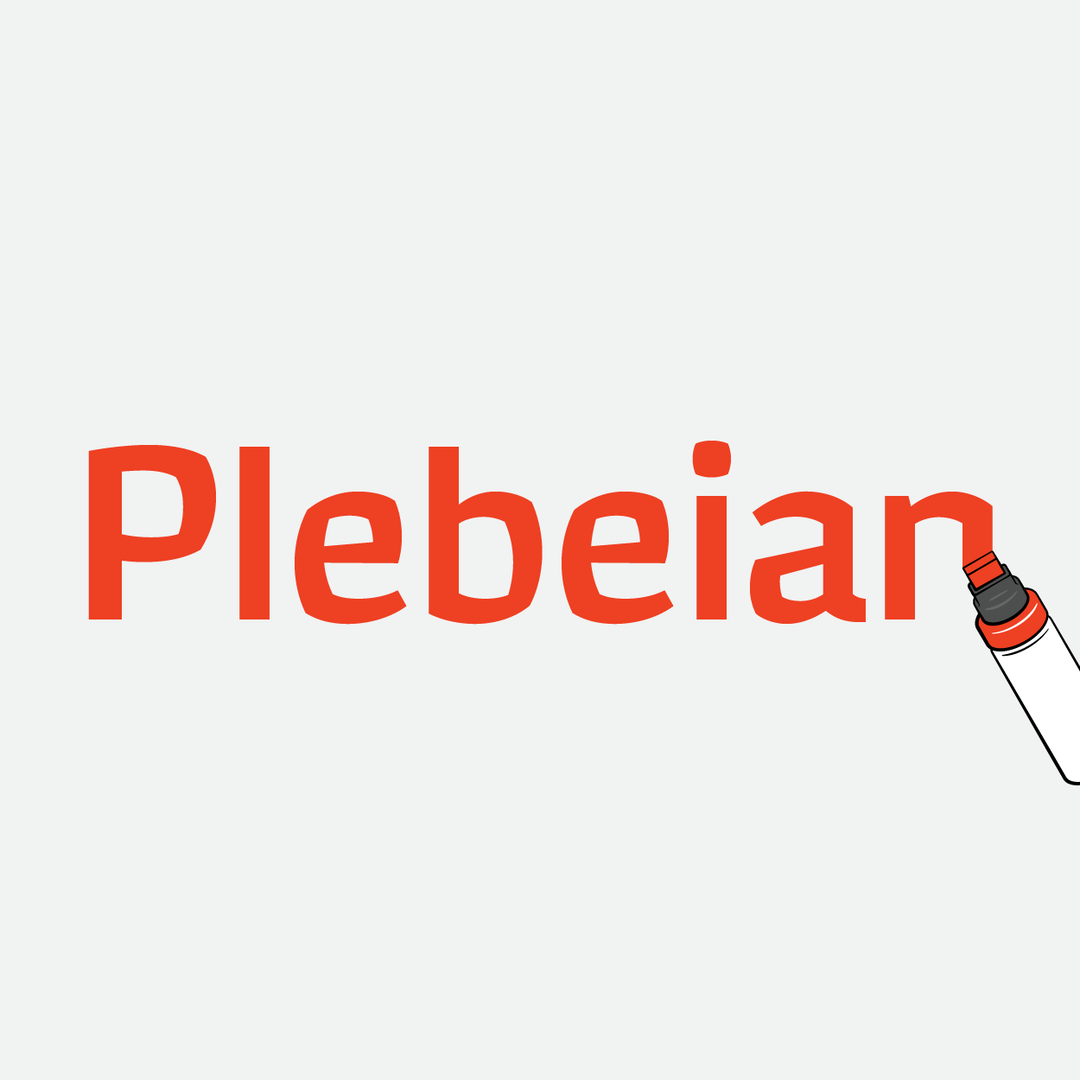
1 of 5
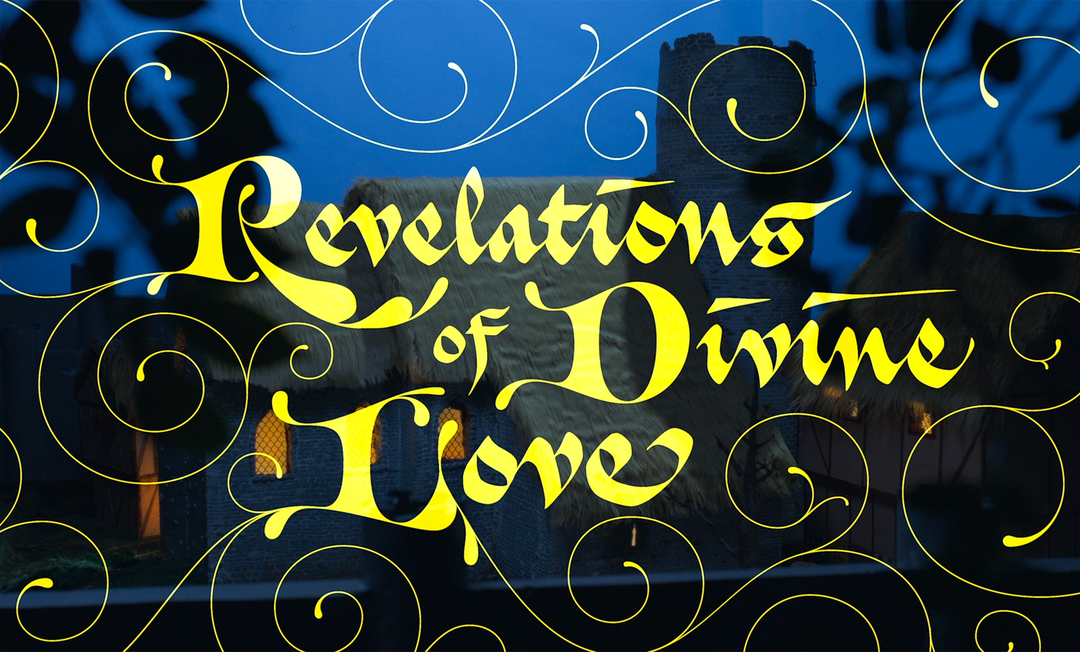
Benjamin Tuttle: Lettering design and animation for Revelations of the Divine Love titles (Copyright © Benjamin Tuttle)
1 of 5
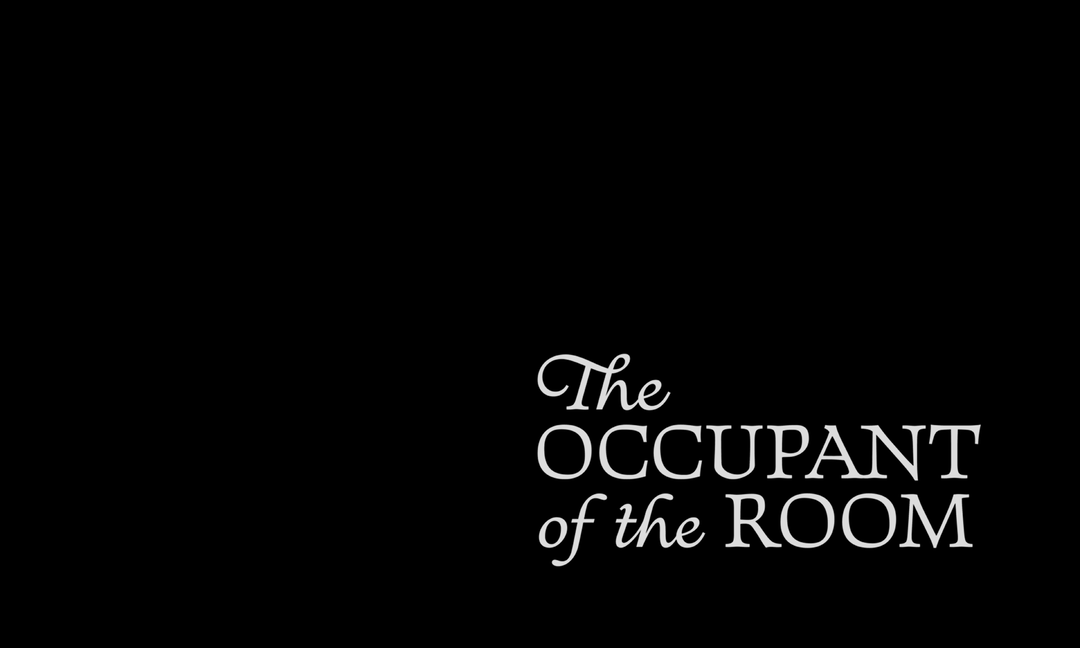
Benjamin Tuttle: Lettering design and animation for Revelations of the Divine Love titles (Copyright © Benjamin Tuttle)
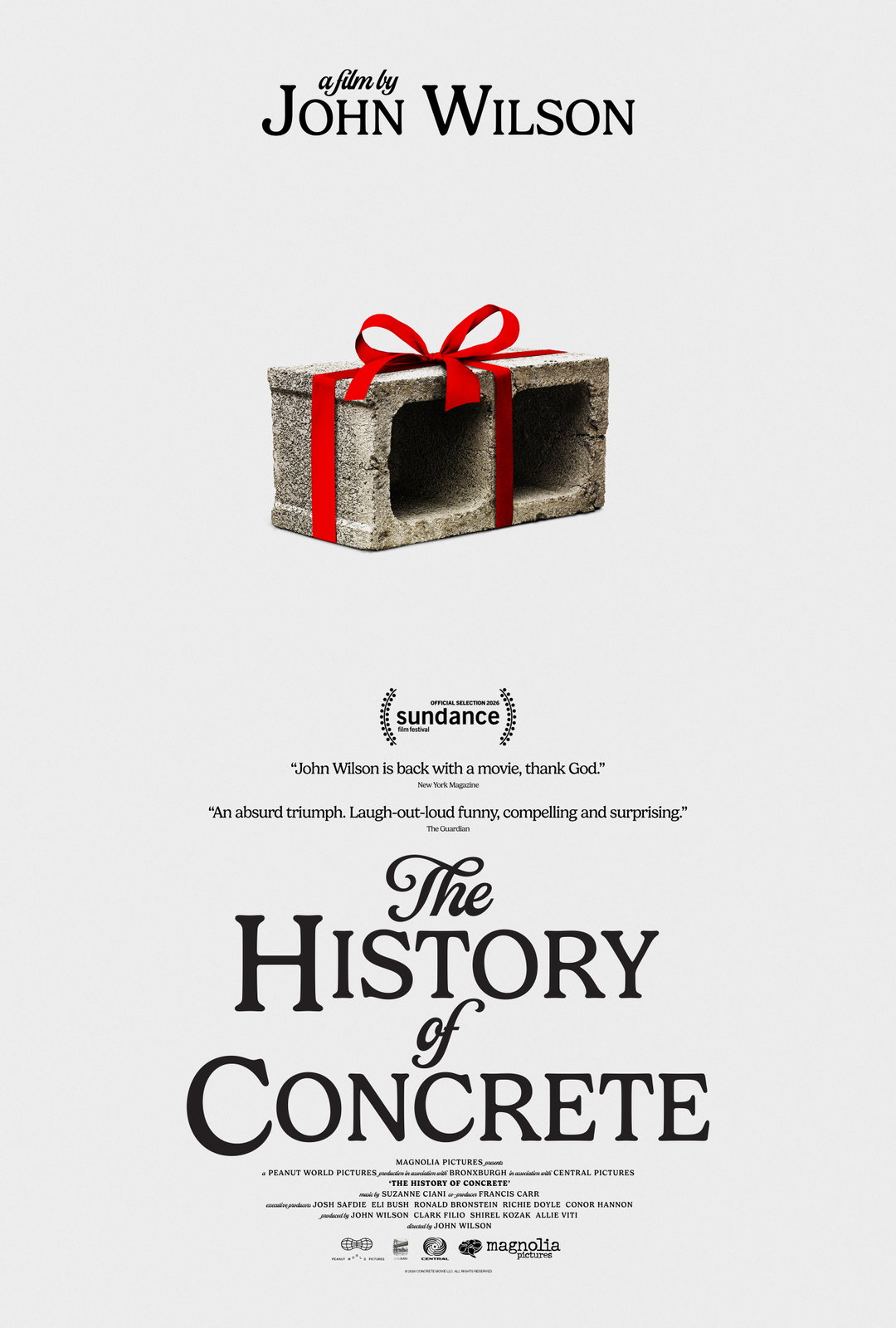
While the work at Spectacle prepared Benjamin to have fun with design, it also landed him Beef, thanks to his meeting with a former volunteer at Spectacle, the director Aaron Schimberg, who would later go on to direct the acclaimed 2024 film A Different Man, and his producer Vanessa McDonnell, also a volunteer. Both Beef and A Different Man fall under A24, and Benjamin’s name was already on A24’s roster because of his work on the latter. This led to one of the producers on Beef, Reuben Lim, contacting him.
“I credit Spectacle with saving my career.”
Benjamin Tuttle
For A Different Man, Benjamin kept pitching ideas of typefaces that were morphed and animated – variable fonts where the serifs shed, from serif to a sans-serif – typographic jokes that mirrored the plot of the film, which is about a man’s transformation. Eventually, they went with something different. “For the main title, I adapted a Bauer typeface called Corvinus, and changed it a fair amount,” Benjamin says. “It had an Art Deco serif quality to it that read as New York to Aaron, even though it is a German typeface. It had the vibe of the city, like something you might see in an early noir or crime film set in New York.”
For Benjamin, the medium and the client can change – from psychedelic Japanese rock bands to spaghettised ICE agents to Netflix’s most talked-about show – but it all comes down to the bare fundamentals of type design; to the rule he made for himself from his days as a student in Cooper Union’s Type@Cooper program: “I will only use fonts that I make in my own work.”
Share Article
Further Info
About the Author
—
Arman Khan is a writer, editor and educator. Formerly, he was the executive editor at Vogue India. He writes at the intersection of culture and fashion with a sociological lens.