Stefania Orfanidou photographs the city of L’Aquila in the wake of natural disaster
Growing up in Kavala in northern Greece, surrounded by books on art, history and archaeology, and steeped in Greece’s rich classical and Hellenistic heritage, photographer Stefania Orfanidou was initially set on becoming an archaeologist herself. “In the end,” she tells us, “I chose architecture – and I haven’t regretted this choice.” It was during her architectural studies in Thessaloniki that Stefania first began practicing photography, but it wasn’t until her year abroad in Madrid that she started taking it more seriously as a medium that could fulfil her “inner need to explore myself and express thoughts and feelings.”
Photography, for Stefania, is about storytelling; it is, in her words: “a means of creating narration, editing and experimenting with images as if they are words, slowly forming a sentence and then a paragraph.” Her project and publication, Pendulum, is a visual recounting of her personal experience of returning to the city where her parents met in 1977 – L’Aquila. The city’s historic centre having been turned to rubble by an earthquake, Stefania was enlisted in an architectural capacity in the project of reconstruction. As a way of comprehending her relation to the city’s trauma, she documented the “unrecognisable post-seismic terrain” with a series of photographs. Her visit was, therefore, an intermingling of different spheres of her life: her family biography, her professional work and her mode of creative expression.
Stefania describes her encounter with the broken site of her parents’ meeting: “The earthquake had created an open wound in the body of the city and in the minds of its citizens. It also created a rupture in my childhood memory that was moulded by stories and my two visits to the city before the disaster. I tried to close this rupture by capturing photographically its imprints and its consequences. This was a process of re-writing the memory of the place, as an act of reconciliation with L’Aquila.”
Stefania Orfanidou: Pendulum
Of the project’s title, Stefania states: “The pendulum’s oscillation is metaphorical and real at the same time. It refers to the uncertain period of time between the beginning of the reconstruction and its completion; by my departure, it hadn’t been finished. It also refers to the cranes’ literal swaying, dominating the skyline of the city, swinging back and forth above our heads with the wind, even when the construction sites were closed. Finally, Pendulum represents a personal oscillation, since my time in L’Aquila was a transitional period, a temporary pause in a place that had become a non-place.”
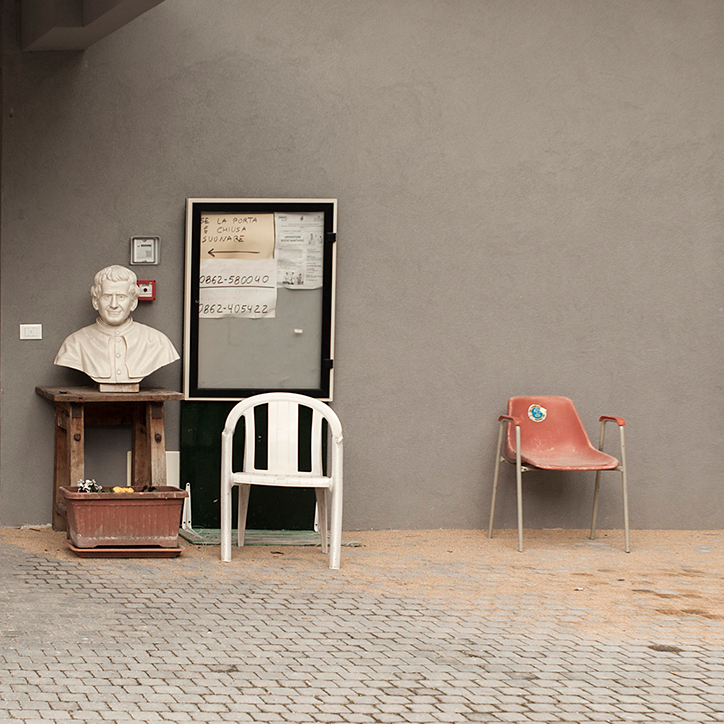
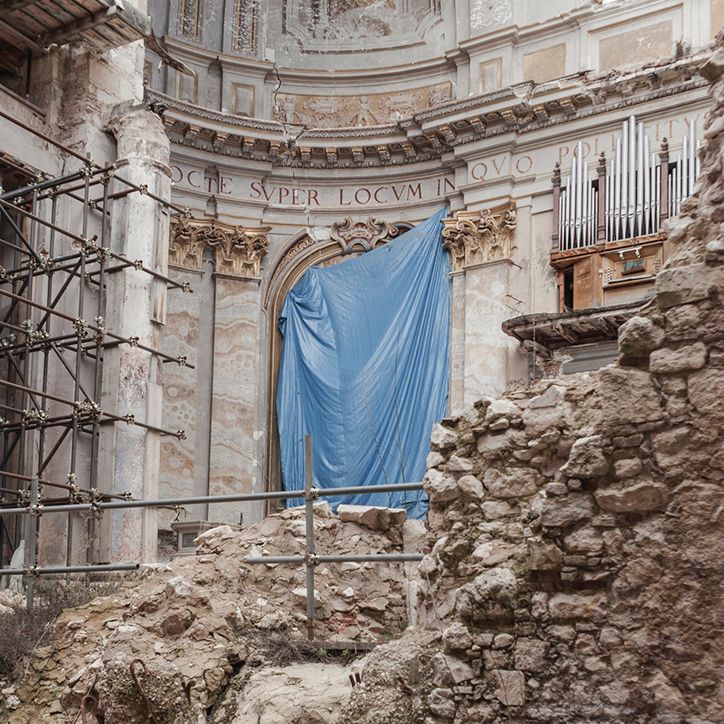
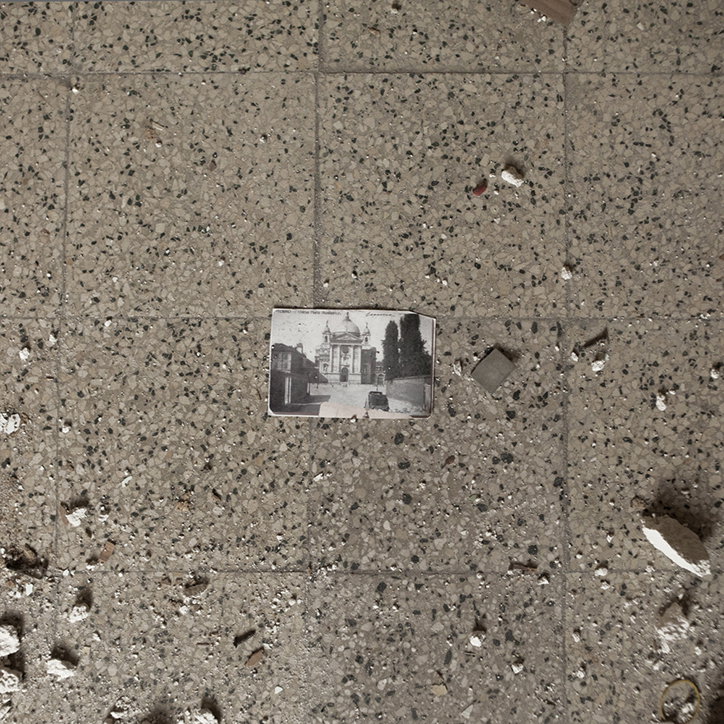
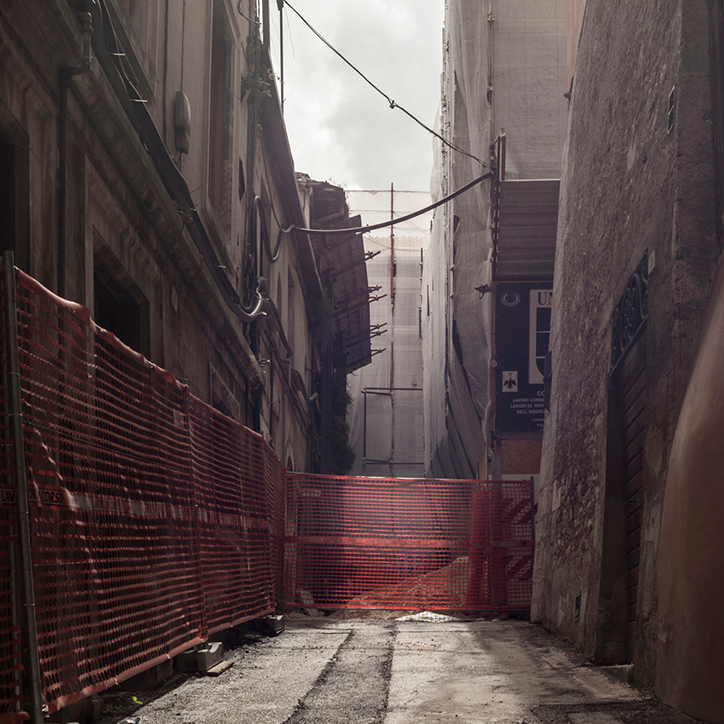
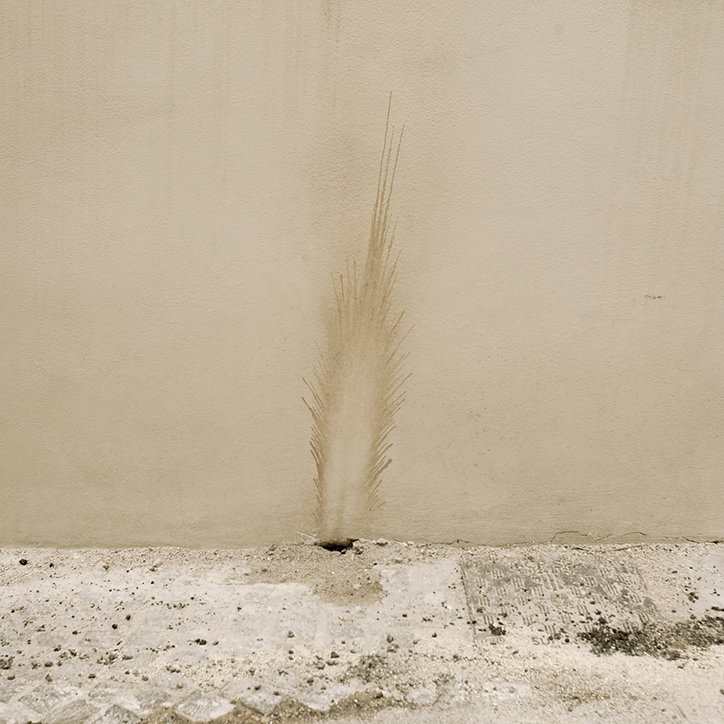
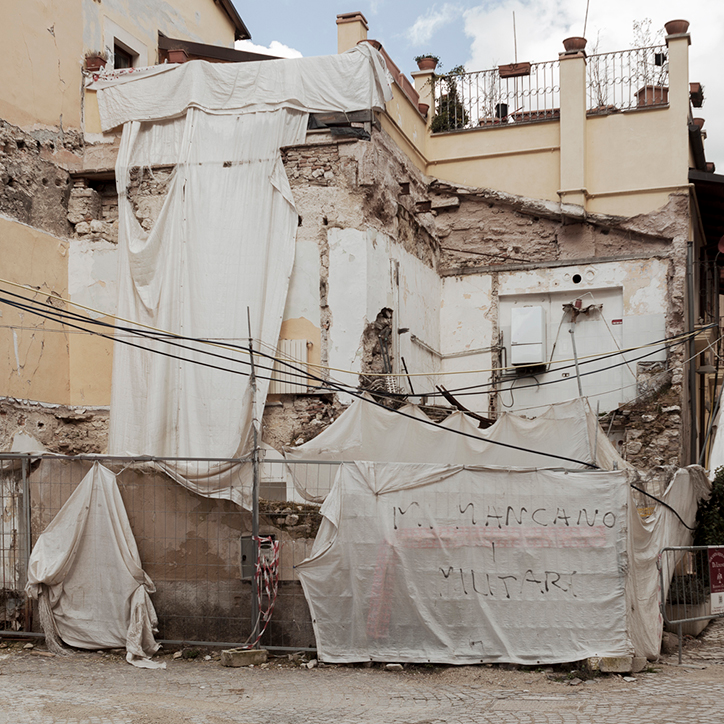
This reduction of place to non-place is palpable in Pendulum: streets once walked by their residents are cordoned off by red plastic mesh; houses once inhabited are shrouded with heavy sheets and surrounded by metal fencing; historic monuments are supported by scaffolding and hung with tarpaulin; a postcard and a book lie crumpled and dusty. In one shot of a high rooftop vista, the pendulum-like cranes rise tall and ominous throughout the city, reminders of the “wound” that has not yet been closed. The L’Aquila of Stefania’s photographs is suspended at the interim between disaster and recovery.
Stefania conceives of Pendulum as a story told through interconnecting images which collectively speak of the process of “healing from the trauma”. However, she recognises “there are images with more intensity and strength, that possess a pivotal role and function as ‘key-images’ within the narration. Such images are the ones depicting the interior of the destroyed cathedral, with a fresco covered by a blue veil, and another of the destroyed balcony of a recently restored house. Both communicate in a direct way L’Aquila’s wound, and they function as the threshold between the consequences of the disaster and the imminent reconstruction of the city.”
Stefania Orfanidou: Pendulum
Stefania Orfanidou: Pendulum
Stefania Orfanidou: Pendulum
Stefania Orfanidou: Pendulum
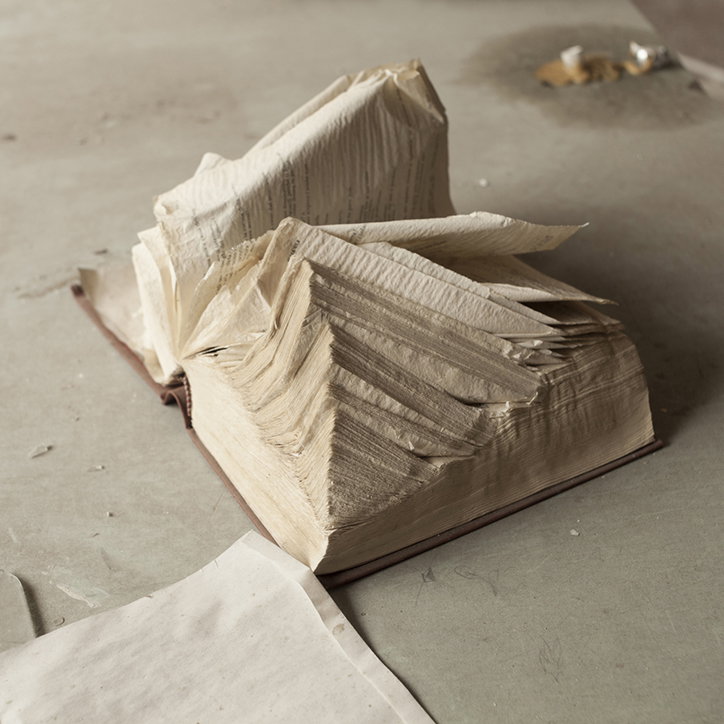
Stefania Orfanidou: Pendulum
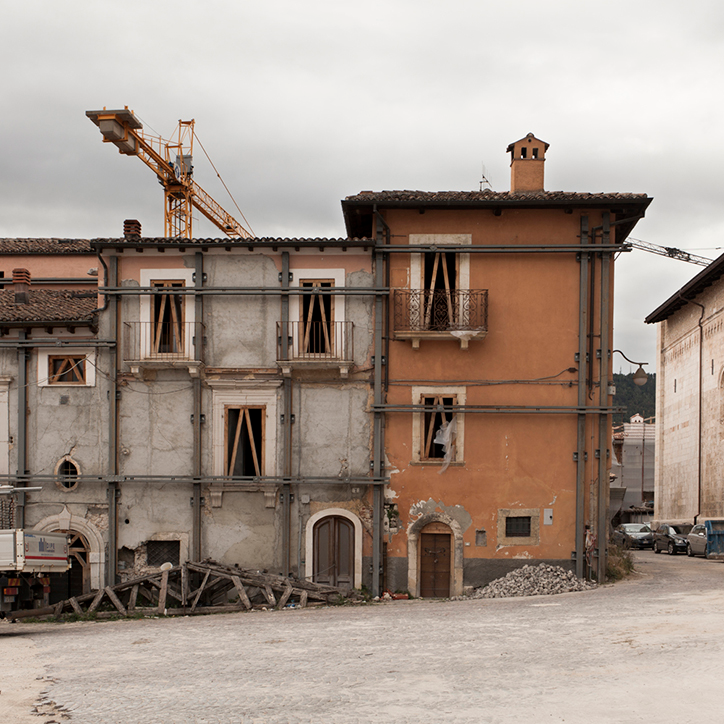
Stefania Orfanidou: Pendulum
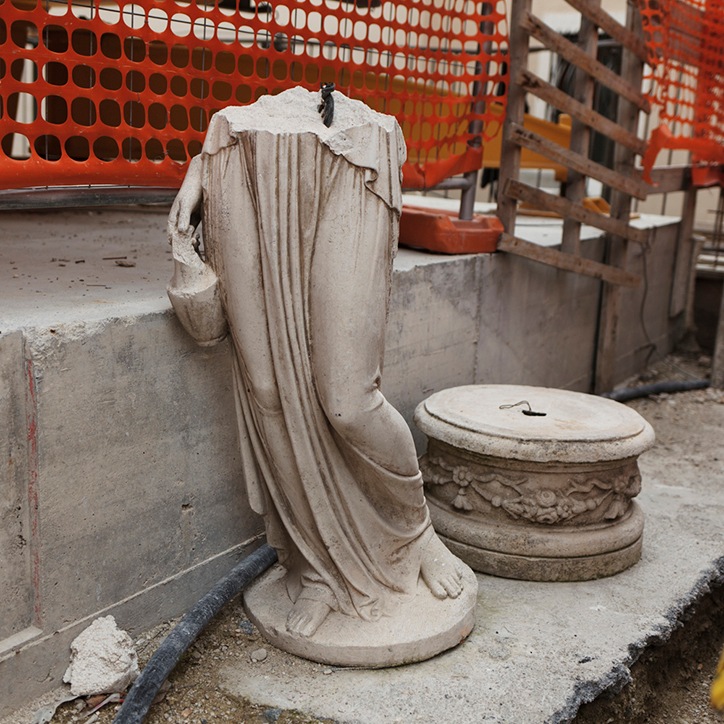
Stefania Orfanidou: Pendulum
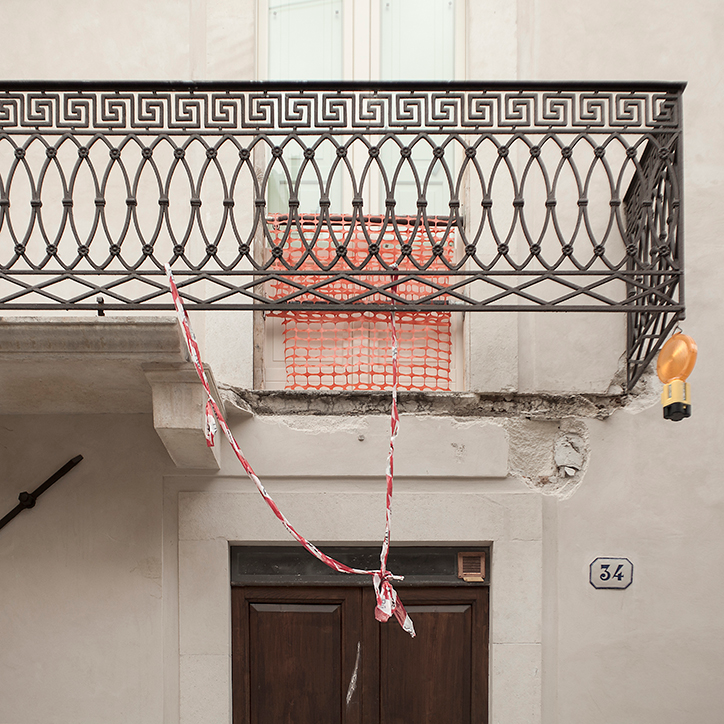
Stefania Orfanidou: Pendulum
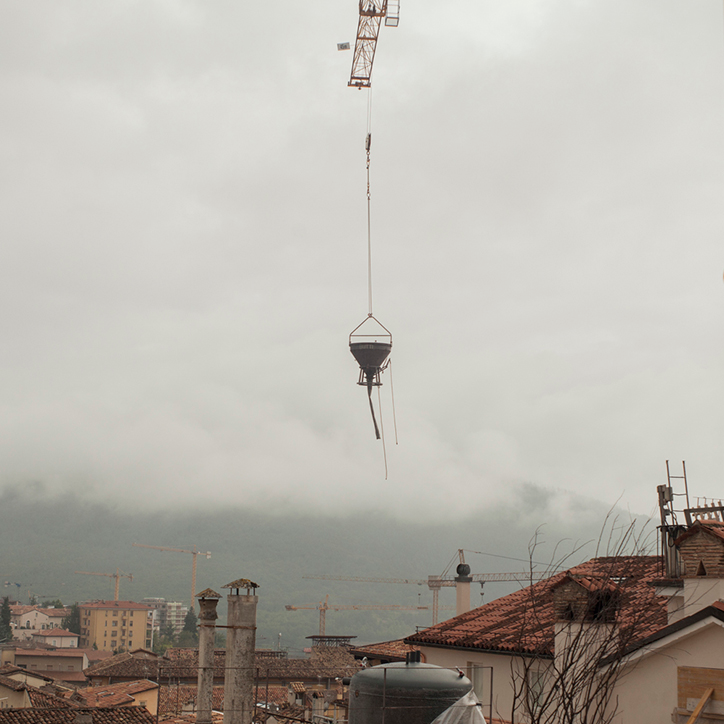
Stefania Orfanidou: Pendulum
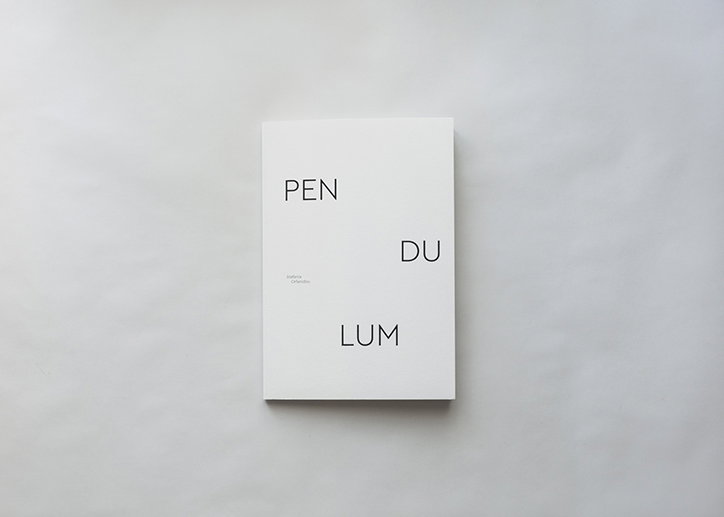
Stefania Orfanidou: Pendulum
Share Article
Further Info
About the Author
—
Rowe joined It’s Nice That in the summer of 2019 as an editorial assistant. She wrote many fantastic stories for us, mainly on hugely talented artists and photographers.