Duane Hanson’s hyperreal sculptures question how we address the world
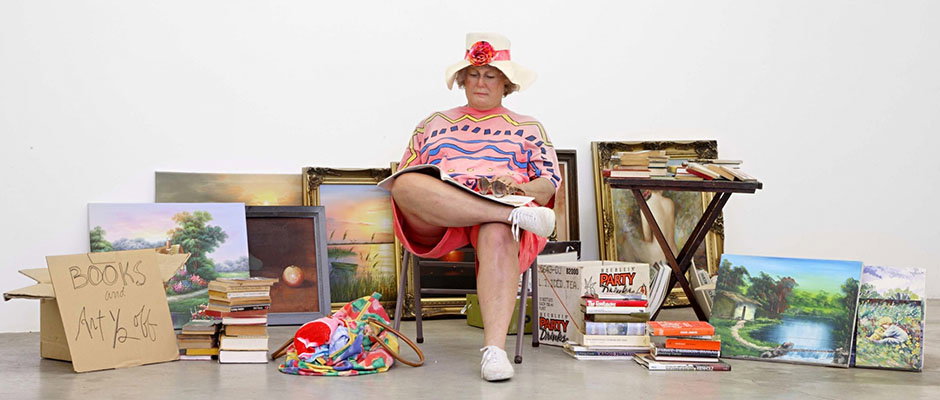
Walking through the doors of the Serpentine Sackler Gallery you’re instantly met by Duane Hanson’s Flea Market Lady parading her worldly belongings in a yard sale. You expect her to look up and acknowledge your arrival, but she remains still. Even though you know she’s a mixed media amalgamation of oil, bronze and plastic, a part of you still expects her to glance away from her magazine. This unnerving feeling follows you throughout the Duane Hanson retrospective and his sculptures exude such an overwhelming presence it’s both captivating and unsettling.
The American artist worked from the late 60s to the mid 90s and here Duane’s hyperreal sculptures of ordinary folk sit within the confines of white-washed walls and reddish bricks. It’s been nearly 20 years since Duane’s work was last shown in London and despite some works being tinged with the clothes and paraphernalia of bygone eras, they still feel relevant today. We can be so obsessed with ourselves, the show forces us to pause as we quietly meander through Hanson’s everyday, making us question our own and the people we overlook.
Created using bronze, resin or polyvinyl, painted in soft oils and using real clothes, the detail and realness is disconcerting. Whether intended or not with the curation, visitors begin to look like extra sculptures as they stand perfectly still, staring or taking photographs. It’s an eerie few seconds when we, the sculptures and the real people, are simultaneously frozen and the whole gallery is still.
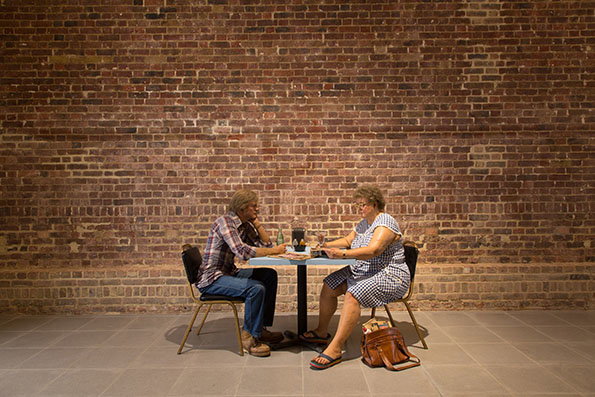
Duane Hanson: Self-Portrait with Model, 1979. Photo by Luke Hayes
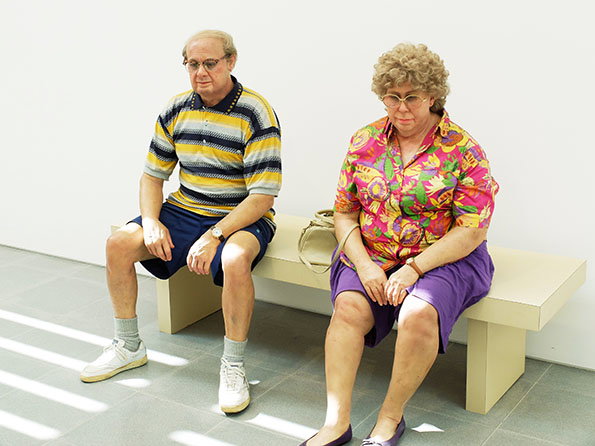
Duane Hanson: Old Couple on a Bench, 1994. Photo by John Offenbach
The quiet melancholy to many of the pieces is beautiful. You can feel the weariness of Quennie II as she takes a break from wheeling her bin stacked with cleaning products, and the builders’ despondency from their slouched shoulders in Lunchbreak as they sit staggered on the scaffolding.
Critics of Hanson’s depiction of working and lower-middle class America say he reduces these groups to patronising stereotypes but in Douglas Coupland’s essay found in the exhibition catalogue, the novelist notes the confusion many people make between the terms stereotype and archetype: “Stereotypes are exaggerated characteristics temporarily tainted with conscious or subconscious contempt. Archetypes depict universal modes of being that reconfigure themselves over and over again across time, geography and culture.”
In this show, at least to me, archetype is the word more befitting to Duane’s sculptures. The people he focuses on are seemingly unremarkable, they have different body shapes, different skin colours and are performing different actions but they’re all real and unchanged from their natural state. Cast from live models in his studio, the artist paid attention to every feature, from body hair to veins and bruises. Duane’s intention is to reconnect us to the people that don’t stand out, rather than gratuitously gawp like voyeurs – his version of realism makes us question the part we play and how we address the invisible parts of society.
Duane Hanson is at Serpentine Sackler Gallery, London 2 June – 13 September
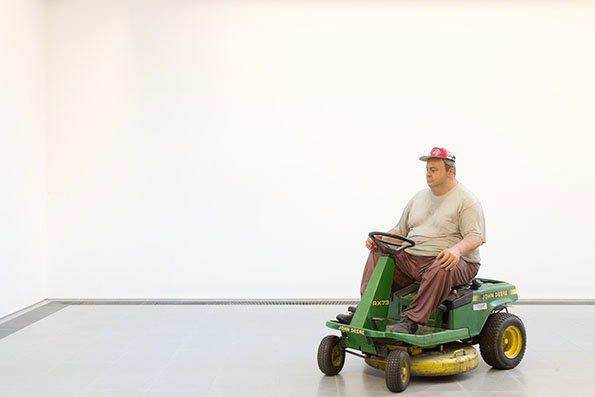
Duane Hanson: Man on Mower, 1995. Photo by Luke Hayes
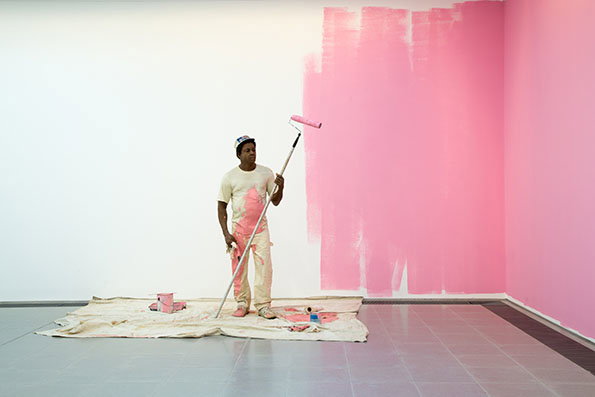
Duane Hanson: House Painter I, 1984/1988. Photo by Luke Hayes
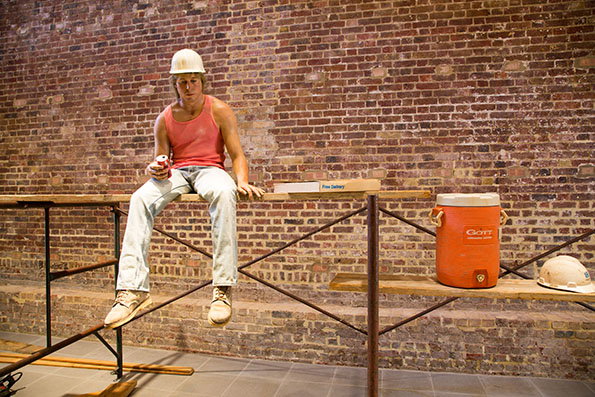
Duane Hanson: Lunchbreak, 1989. Photo by Luke Hayes
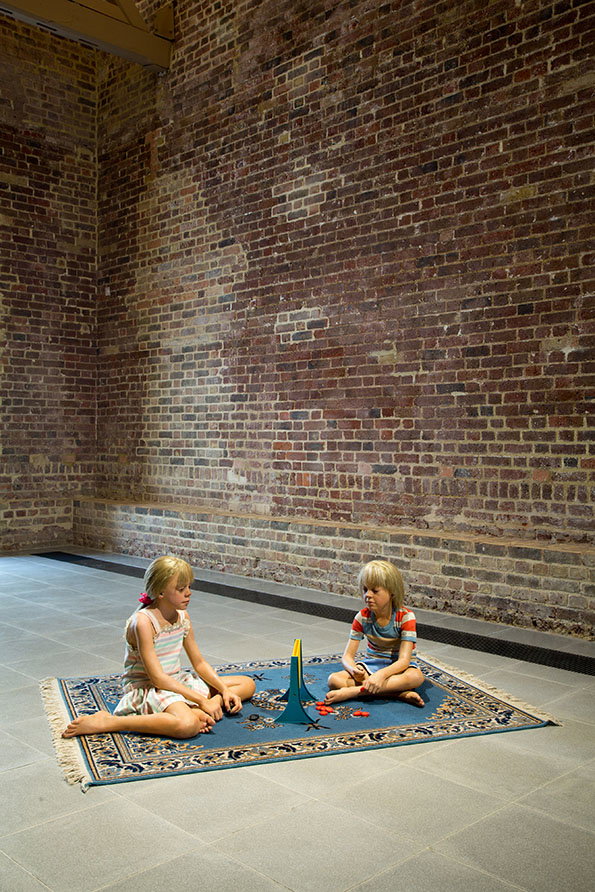
Duane Hanson: Children Playing Game, 1979. Photo by Luke Hayes
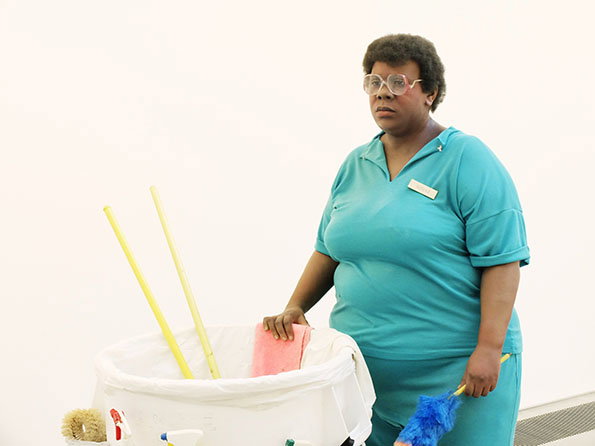
Duane Hanson: Queenie II, 1988. Photo by Luke Hayes
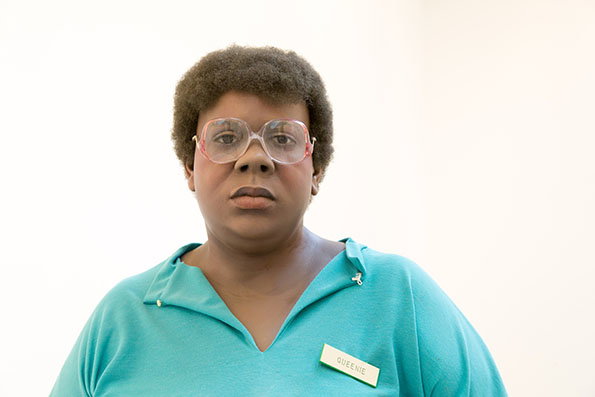
Duane Hanson: Queenie II, 1988 (detail). Photo by Luke Hayes
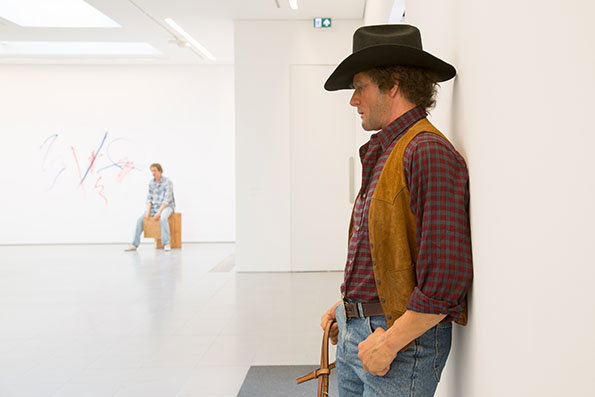
Duane Hanson: Cowboy, 1984/1995. Photo by Luke Hayes
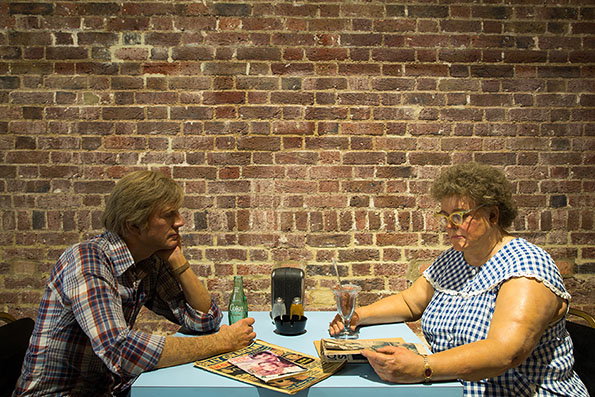
Duane Hanson: Self-Portrait with Model, 1979. Photo by Luke Hayes
Share Article
Further Info
About the Author
—
Rebecca Fulleylove is a freelance writer and editor specialising in art, design and culture. She is also senior writer at Creative Review, having previously worked at Elephant, Google Arts & Culture, and It’s Nice That.